What Does an OBD2 Scanner Do ? A No-Hype Guide to Car Diagnostics
My check engine light came on during a road trip about 45 minutes outside of town. No sputtering, no smoke, no obvious sign of trouble—just that amber glow staring at me from the dash. I pulled over, popped the hood, looked around, found nothing obviously wrong, and drove the rest of the way home wondering if my car was about to self-destruct or if a gas cap had come loose. A trip to the shop the next morning cost me $95 before a single wrench was touched—that was just the diagnostic fee. The fault code? P0455. Evaporative emission system, large leak detected. The fix? Tighten the gas cap. That was the day I bought my first OBD2 scanner, and I haven’t paid a diagnostic fee since.
If you’ve landed here, you’re probably staring at a check engine light of your own, or you’ve been burned by a shop bill that felt suspiciously high, or you’re just tired of feeling like you have no idea what’s actually going on with your car. An OBD2 scanner gives you access to the same basic data your mechanic pulls up when you walk through the door. Understanding what these tools do—and which one fits your situation—is the difference between walking into a repair shop informed and walking in blind.
Quick Comparison: Top OBD2 Scanners at a Glance
| Scanner | Best For | Systems Covered | Live Data | Display | Updates | Price Tier |
|---|---|---|---|---|---|---|
| ANCEL AD310 | Beginners, basic CEL reading | Engine only | Yes | LCD monochrome | Via USB | Budget (~$25) |
| Autel AL319 | DIYers, emissions checks | Engine, I/M Readiness | Yes | TFT color | Via USB | Budget (~$35) |
| FOXWELL NT604 Elite | Multi-system diagnostics, mid-level DIY | Engine, ABS, SRS, Transmission | Yes, with graphs | Color LCD | Lifetime free (WiFi) | Mid-range (~$70–$90) |
| Professional-Grade (Autel MK808 class) | Shops, serious enthusiasts | Full systems + bidirectional | Yes, advanced | Large touchscreen tablet | Subscription-based | Premium ($200–$600+) |
| Bluetooth/Wireless (e.g., Veepeak OBDCheck) | Smartphone users, light monitoring | Engine (app-dependent) | Yes, via app | Your phone screen | App-dependent | Budget (~$20–$40) |
The OBD2 Standard: What It Is and Why It Matters
OBD2—On-Board Diagnostics, second generation—is the standardized system that every passenger vehicle sold in the United States since model year 1996 must have. The federal government mandated it primarily to support emissions testing programs. The EPA’s OBD program notes that the technology plays a central role in helping states meet national air quality standards by giving technicians and vehicle owners timely, accurate data on how a car’s emissions systems are performing.
Before OBD2 existed, each automaker had their own proprietary diagnostic systems. A Ford dealership’s equipment wouldn’t work on a Honda. OBD2 changed that. Every compliant vehicle uses the same 16-pin port in the same general location, follows the same communication protocols, and stores fault codes in a standardized format. That’s why a $30 scanner bought online can read the same data as a $3,000 professional shop tool—at least for the basics.
The system works because your car’s engine control unit (ECU) and other module controllers continuously run self-tests called readiness monitors. These evaluate everything from oxygen sensor performance to fuel system integrity to catalyst efficiency. When something fails a threshold, the module stores a diagnostic trouble code (DTC) and—depending on severity—illuminates the malfunction indicator lamp on your dashboard. That’s the check engine light. An OBD2 scanner is simply the device that retrieves what’s stored.
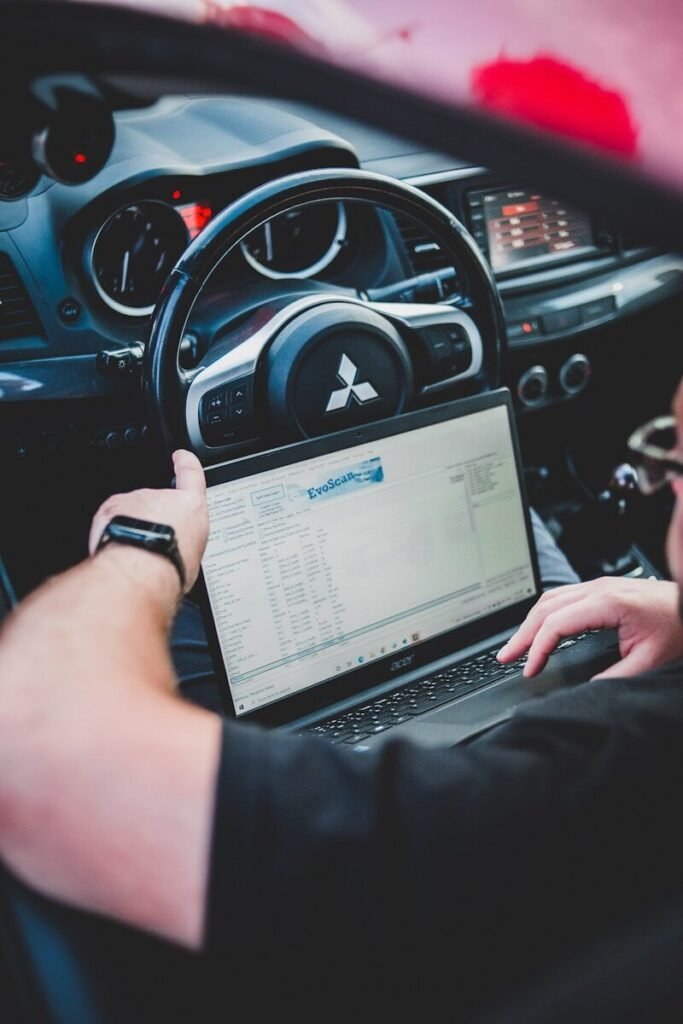
The Five Core Things an OBD2 Scanner Actually Does
1. Read Diagnostic Trouble Codes
This is the fundamental function every scanner shares. When your check engine light comes on, there’s one or more DTCs stored in your ECU. The scanner pulls them out and displays them—typically as a five-character code like P0300 (random misfire detected) or P0171 (system too lean, bank 1). Better scanners also display a written description of what the code means, so you’re not left Googling the code in the parking lot. Even the cheapest scanners on the market do this reliably.
2. Clear Codes and Reset the Malfunction Indicator Lamp
Once you’ve noted the code and addressed the underlying issue—or at least confirmed the issue—you can clear it from the ECU’s memory. This turns the check engine light off. If the problem was a loose gas cap, the light stays off. If the engine is genuinely misfiring and you just cleared the code without fixing anything, the light will return within one to three drive cycles. Some codes also have “pending” status—flagged once but not enough to trigger the MIL yet. Seeing pending codes is one of the things that separates a thorough scan from a quick look.
3. Read Live Sensor Data
This is where things get genuinely useful beyond just seeing fault codes. Your car has dozens of sensors feeding real-time data to the ECU—coolant temperature, mass airflow, oxygen sensor voltage, throttle position, engine RPM, vehicle speed, fuel trim values, and more. A scanner can display these live, either as numbers or graphically. If you suspect an intermittent issue, being able to watch sensor values while driving can catch a failing sensor that doesn’t trigger a stored code. Most mid-range and budget scanners support live data; how clearly they display it varies.
4. Check Emissions Readiness (I/M Readiness)
This function is underused and underappreciated. Before your state’s emissions inspection, your vehicle’s OBD2 system needs to have completed its internal self-tests—the readiness monitors. If you recently cleared codes or replaced your battery, those monitors reset to “incomplete” and need to run through their cycles on the road before they’ll be marked ready. If you show up for inspection with incomplete monitors, many states will reject or fail your vehicle even if no fault codes are present. An I/M readiness check on your scanner tells you exactly which monitors have passed and which are still pending, so you know whether it’s worth making the trip yet.
5. Freeze Frame Data
When a fault code is set, your vehicle’s ECU takes a snapshot of sensor values at that exact moment—engine load, RPM, vehicle speed, fuel system status. This is freeze frame data, and it’s invaluable for diagnosis. A misfire that only happens under heavy acceleration at 3,000 RPM looks very different in freeze frame than one that occurs at idle. The freeze frame gives you, or your mechanic, the operating conditions at the moment of the fault rather than a generic code that could have a dozen different causes.
What OBD2 Scanners Cannot Do
Basic scanners only read and clear engine-related codes—they don’t touch ABS, airbag, or transmission systems. So if your ABS light is on, a $25 code reader is going to leave you staring at a blank screen. You’ll need a scanner that specifically advertises multi-system coverage. That’s not a marketing upcharge; it’s a genuine hardware and software difference. The protocols for accessing non-engine modules require additional decoding.
No scanner—regardless of price—can repair anything. It can tell you what the car’s computer thinks is wrong. That’s enormously useful. But a P0420 (catalytic converter efficiency below threshold) might mean the catalytic converter is actually failing, or it might mean an oxygen sensor is giving incorrect readings, or it might mean an upstream exhaust leak is skewing the data. The scanner names the fault; the diagnosis still requires mechanical judgment. This is the distinction shops exploit when they charge a diagnostic fee even after they’ve already scanned your car. The scan is 30 seconds; the diagnosis takes time.
OBD2 scanners also can’t tell you the market value of the repair, which shop to trust, or whether the quote you’re getting is honest. For that, I’ll just say this: once you know the code and understand what system it points to, a quick search for the repair cost on your specific make and model takes three minutes and gives you a reasonable price range before you agree to anything.
How to Use an OBD2 Scanner (It’s Simpler Than It Sounds)
Locate the OBD2 port—it’s under the dashboard on the driver’s side, usually within arm’s reach of the steering column. On most vehicles it’s exposed; on a few it’s behind a small plastic cover. Plug the scanner cable in firmly until it seats. Turn your ignition to the “on” position without starting the engine, or start the engine—either works for most functions. The scanner powers up directly from the port.
From there you navigate the scanner’s menu: most have a dedicated “Read Codes” function that runs the scan automatically. The whole process from plug-in to reading codes typically takes under a minute. If the scanner asks for vehicle information, some have auto-detect via VIN; others ask you to enter year, make, and model manually. Once codes are displayed, write them down before clearing anything. That’s it. When you’re done, pull the scanner straight out—don’t twist it.
“On-Board Diagnostics (OBD) offers significant benefits to state and local agencies working to improve air quality through vehicle inspection and maintenance programs. By providing technicians with timely and accurate emissions data and helping vehicle owners better maintain their vehicles, OBD plays a key role in helping states meet national air quality standards.”
— U.S. Environmental Protection Agency, Vehicle Emissions On-Board Diagnostics Program
Understanding OBD2 Trouble Code Structure
The five-character code format isn’t arbitrary. The first letter identifies the system: P for powertrain, B for body, C for chassis, U for network communications. The second character—0 or 1—tells you whether it’s a standardized generic code (0) shared across all manufacturers, or a manufacturer-specific code (1) that may require the OEM’s own documentation to interpret accurately.
The third digit points to the subsystem. P0-3__ codes cover fuel and air metering; P04__ codes are emission controls; P05__ codes are vehicle speed and idle control; P06__ codes are computer output circuits. The final two digits are the specific fault identifier. Armed with just the five-character code and your vehicle’s year and model, you can find detailed repair information from forums, YouTube, and repair databases that rival what a shop technician looks up in their paid subscription tools.
Handheld vs. Bluetooth OBD2 Scanners: Which Makes More Sense for You
Handheld scanners have their own screen, cable, and dedicated hardware. They work independently—no phone required, no app to update, no Bluetooth pairing. For someone who wants to scan a car quickly in a parking lot or check a code without fumbling with their phone, a dedicated handheld is faster and more reliable. They also tend to support more vehicle protocols out of the box. The downside: you carry another device, and the screen is smaller than a smartphone display.
Bluetooth adapters plug into the OBD2 port and transmit data wirelessly to an app on your phone. The appeal is obvious—your phone has a large, bright screen, you probably always have it with you, and good diagnostic apps can display data beautifully. The limitation is that these adapters vary wildly in quality, and the app is often the weak point. Some apps charge monthly fees. Some protocols—particularly for older Ford and GM vehicles using J1850 PWM—work poorly or not at all on budget Bluetooth adapters. If you go the Bluetooth route, buy from a reputable brand and research whether the adapter works with your specific vehicle.
For the majority of car owners who want reliable plug-and-play function without app subscriptions, a mid-priced handheld scanner hits the sweet spot.
What the Lights and Readiness Monitors Actually Mean
A solid check engine light means a fault has been detected and a DTC is stored. A flashing check engine light is a different situation entirely—that indicates a misfire severe enough to damage the catalytic converter and warrants pulling over or at minimum reducing speed and load immediately. Don’t ignore a flashing MIL the way you might shrug off a steady one.
Readiness monitors are internal self-test routines that run in the background while you drive. There are typically 11 monitors on most vehicles, but not all apply to every car—some monitors are relevant only to specific fuel system designs. Monitors that show “complete” or “ready” have passed their self-test. Monitors showing “incomplete” or “not ready” haven’t had enough drive cycles to run. This matters enormously for emissions testing, and it’s the reason a quick code clear before an inspection can actually cause you to fail a test you otherwise would have passed.
OBD2 Scanners and Your Car’s ABS, Airbag, and Transmission Systems
The check engine light is connected to the powertrain control module. It is not connected to your ABS module, your supplemental restraint system (airbag) module, or your transmission control module. Those systems have their own warning lights on your dashboard—ABS light, airbag light, transmission warning—and their own fault codes. A basic OBD2 scanner reading only engine codes will see nothing wrong when you have an ABS fault.
This is where paying a bit more for a multi-system scanner pays for itself quickly. ABS codes tend to be straightforward—wheel speed sensor failures, module faults—and knowing the specific code before heading to a shop is the same advantage you get with engine codes. A brake job is already expensive enough without paying an additional diagnostic fee on top. If you’ve been doing your own brake work—and our guide to the best brake bleeder kits walks through the process thoroughly—having a scanner that can read and clear ABS codes is a natural complement.
When a Scanner Saved Me Real Money (And When It Didn’t)
The gas cap story I opened with is the obvious example. But there’s a less obvious one that matters more. A friend’s car threw a P0128, which points to the engine coolant temperature running below normal operating range—usually a thermostat that’s stuck open. The shop quoted $380 for the repair. The thermostat on that engine costs $18 and takes 45 minutes to replace if you’re not in a hurry. Without the code, without knowing where to look, he would have paid $380 without question.
Where a scanner doesn’t save you money: when the code points to something genuinely complex, like a P0300 random misfire with no obvious cylinder-specific pattern. That code can mean spark plugs, coil packs, fuel injectors, vacuum leaks, compression issues, or a combination. Knowing the code tells you the territory; you still need someone who knows how to navigate it. A scanner is a starting point, not a repair manual.
Getting Under the Hood Without a Creeper: Practical Tips
Using your scanner effectively often means getting visual access to components the code points toward. Vacuum lines, exhaust manifolds, sensors with accessible connectors—these are things you can inspect yourself before committing to a repair. A topside creeper makes engine bay work significantly more comfortable, especially on trucks and taller SUVs where leaning over the engine for thirty minutes is a back problem waiting to happen. If you’re going to use your scanner as an excuse to start doing more of your own maintenance, having the right positioning equipment matters.
Similarly, if a code points to an oil system fault—oil pressure sensor, variable valve timing solenoid requiring a clean oil system—and you want to handle an oil change yourself as part of the diagnostic process, having a solid oil filter wrench makes that job cleaner and prevents the stripped-filter frustration that turns a simple maintenance task into an ordeal. And when you’re working under a hood or around oily components, a good pair of nitrile gloves keeps your hands clean and protects them from chemicals without sacrificing the grip you need to handle connectors and sensors.
Our Top OBD2 Scanner Picks
ANCEL AD310 — The No-Nonsense Entry-Level Pick

The AD310 is built around ABS-grade plastic housing with a 2.5-foot cable fitted with thick, flexible insulation—it feels more durable than its price suggests. The monochrome LCD display is 128 x 64 pixels, backlit, and large enough to read without squinting. Four physical buttons handle all navigation: up, down, enter, exit. It draws power directly from the OBD2 port with no batteries required.
What it does well in real use: it scans fast, displays DTC definitions directly on-screen so you don’t need your phone open, and handles all five OBD2 protocols including CAN—which matters for compatibility with vehicles post-2008 when CAN became mandatory. It reads and clears engine codes, shows freeze frame data, runs I/M readiness checks, and displays live PCM data stream. On a 2019 F-150, a 2015 Camry, and a 2010 Civic, it connected and pulled codes within 10 seconds each time.
The honest limitation: this scanner covers engine codes only. No ABS, no airbag, no transmission. If your ABS light is on, this tool won’t help with that specific problem. It also doesn’t support service resets or oil light clearing. For someone who owns one car, wants to understand what the check engine light means, and isn’t planning to become their own full-service mechanic, the AD310 does exactly what it promises.
Best for: first-time scanner owners, anyone who wants a fast reliable CEL reader to keep in the glove box, and drivers who primarily want to avoid $100 diagnostic fees at shops.
Autel AL319 — The Smarter Budget Pick With Color and One-Click Emissions
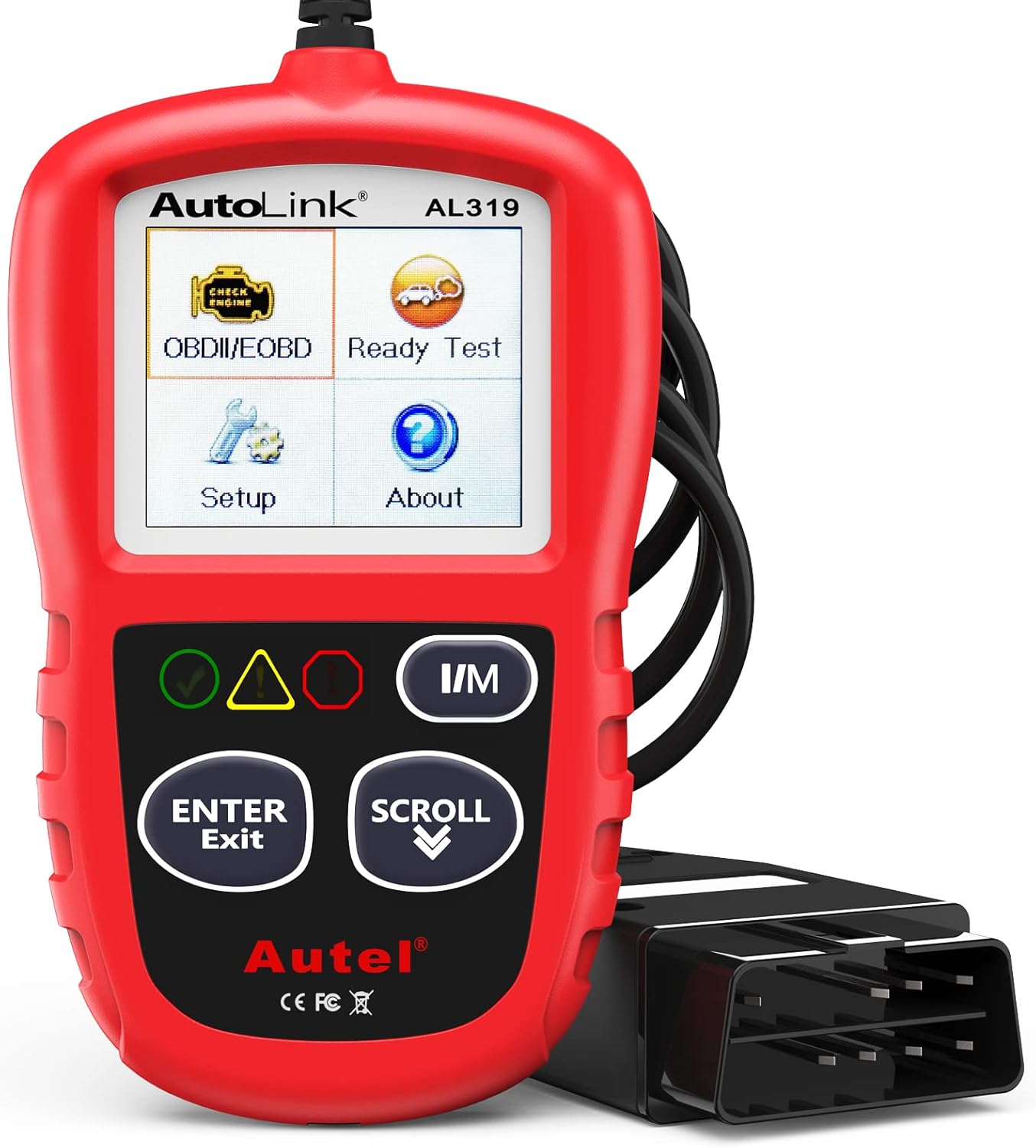
The AL319 is physically similar to the AD310 but adds a TFT color display (220 x 176 dpi) and a feature Autel calls One-Click I/M Readiness—a dedicated button that runs the emissions monitor check instantly. Color-coded LEDs (green for all-clear, yellow for incomplete monitors, red for faults present) give you a quick visual status before you even read the text. A built-in speaker adds an audible tone to match. The unit supports multilingual menus in seven languages.
In use, the color screen makes a genuine difference when reviewing live data—it’s easier to distinguish values quickly. The one-click I/M readiness function is genuinely useful if you’re in the habit of doing your own maintenance and want to confirm emissions monitor status before an inspection appointment. The AL319 also retrieves manufacturer-specific codes (P1 and U1 codes) in addition to generic ones, which can reveal fault descriptions that a generic scanner might display as “unknown code.”
Where it falls short: still engine-only coverage, same as the AD310. No ABS, no SRS. The cable is slightly shorter and the build feels marginally lighter—fine for a glove box tool, less ideal if you’re scanning cars repeatedly in a shop environment. It’s also priced about $10 more than the AD310 for what is largely a display and convenience upgrade.
Best for: car owners who do their own oil changes and light maintenance, live in a state with emissions testing, and want a reliable scanner with a better display and emissions-specific features over a bare-minimum reader.
FOXWELL NT604 Elite — The Real-World Multi-System Scanner for Serious DIYers

The NT604 Elite is built around a hard plastic housing with a solid protective carry case included—a genuine differentiator in this price range, where most competitors ship in a plastic bag. The color LCD display is larger than the budget options, and the interface navigates with five directional buttons that respond predictably. Importantly, this scanner covers engine, ABS, SRS (airbag), and transmission systems in a single tool, making it the first pick on this list that can actually read an airbag light or ABS warning code.
The live data display includes graphing capability, letting you watch sensor values plotted over time rather than just as a number. This matters for intermittent issues—a fuel trim that spikes momentarily under load shows clearly on a graph where it might be easy to miss as a fluctuating number. The AutoVIN feature pulls your vehicle’s VIN automatically, removing the manual entry step. Lifetime free software updates via WiFi keep the vehicle coverage database current without subscription fees.
The critical trade-off to understand: the NT604 Elite is a diagnostic-only tool in these systems. It reads and clears codes but does not perform service functions—no oil service light reset, no electronic parking brake reset, no ABS bleeding function, no battery registration. If you’re doing brake jobs and need to reset the EPB on a newer vehicle, or if you need oil life reset capability, you’ll need to step up to something like the NT614 Elite. For most owners who just want to know what’s wrong across all their warning lights, that limitation rarely comes up in day-to-day use.
Best for: anyone who wants multi-system diagnostic coverage in one affordable tool, owners of vehicles with recurring ABS or SRS warning lights, and DIY mechanics who want professional-range code reading without a professional price tag.
Our Verdict
Here’s the counter-intuitive truth most “best OBD2 scanner” roundups avoid saying: most car owners don’t actually need the scanner they’re being sold. Review sites push mid-to-high-range scanners because the affiliate commissions are better, and because it looks more impressive to recommend a $200 tool. The reality is that for someone who owns one or two personal vehicles and primarily wants to understand check engine lights and avoid unnecessary shop diagnostic fees, a $25 to $35 basic scanner handles about 80% of real-world use cases effectively.
The calculus changes if you have multiple vehicles in your household, work on your own brakes (and need ABS code capability), or live in a state that conducts OBD-based emissions inspections and you want to confirm readiness before your appointment. In those situations, the FOXWELL NT604 Elite or a similarly capable mid-range tool earns its price quickly—one avoided shop visit or one emissions retest fee not paid covers the cost difference between it and a basic scanner several times over.
The one recommendation I’ll make with confidence, backed by the EPA’s own OBD program documentation: check your I/M readiness status before every emissions inspection. It takes 30 seconds and prevents one of the most common, most avoidable inspection failures—showing up with monitors still incomplete after a recent code clear or battery replacement. That one habit alone is worth more than the scanner itself.
If you’re already hands-on with your car—doing oil changes, replacing filters, tackling the occasional brake job—having an OBD2 scanner is the natural next step. A good scanner complements good tools, and it changes how you approach a warning light from anxiety to information. The gap between “I have no idea what’s wrong” and “I know it’s a P0420 and I understand what that means” is the difference between being at the mercy of whatever a shop quotes you and walking in as an informed customer. That has real dollar value every single time you use it.
Frequently Asked Questions
What does an OBD2 scanner do?
An OBD2 scanner plugs into the 16-pin diagnostic port under your dashboard and communicates with your vehicle’s onboard computer to read stored fault codes, display live sensor data, and check emissions readiness. It lets you find out why your check engine light is on without paying a mechanic $100 just for the diagnosis. More advanced scanners can also read ABS, airbag, and transmission codes, reset service lights, and stream real-time data like coolant temperature and engine RPM.
Will an OBD2 scanner work on my car?
Any vehicle sold in the United States from model year 1996 onward is required by federal law to have an OBD2 port, so a standard OBD2 scanner will work on virtually any modern car, truck, SUV, or minivan you’re likely to be driving. European and Asian vehicles sold in their respective markets use different standards, but those sold in the US comply with the SAE J1979 OBD2 standard. If you drive something older than a 1996 model year, OBD2 will not apply.
Can an OBD2 scanner clear the check engine light?
Yes, virtually every OBD2 scanner can clear diagnostic trouble codes, which turns off the check engine light. The important caveat: if the underlying problem hasn’t been fixed, the light will come back on after one to three drive cycles once the vehicle’s monitors detect the fault again. Clearing codes without repairing the issue is useful for confirming a repair worked, or for doing a temporary reset before an emissions test—but it doesn’t fix anything by itself.
What is the difference between a basic code reader and an advanced OBD2 scanner?
A basic code reader reads and clears engine-related diagnostic trouble codes (DTCs) and not much else. An advanced OBD2 scanner goes further: it can read ABS, SRS (airbag), and transmission codes across multiple control modules; stream live sensor data graphically; perform bidirectional tests that send commands to actuators; reset service lights; and in some cases perform key programming or module coding. For most car owners, a mid-range scanner covering engine, ABS, and SRS is the sweet spot—you get far more coverage than a basic reader without paying for professional-shop features you won’t use.
What do the letter codes in OBD2 diagnostic trouble codes mean?
OBD2 fault codes follow a five-character format. The first letter tells you the system: P = powertrain (engine and transmission), B = body, C = chassis, U = network/communication. The second digit is either 0 (generic, standardized across all manufacturers) or 1 (manufacturer-specific). The third digit narrows down the subsystem—0 is fuel and air metering, 3 is ignition, 4 is emission controls, and so on. The final two digits are the specific fault number. So a P0420 means a generic powertrain fault related to the catalytic converter system.
Can an OBD2 scanner help me pass an emissions test?
Yes, and this is one of the most practically useful things a scanner does. Most state emissions tests check your vehicle’s OBD2 readiness monitors—internal self-tests the car runs continuously. If those monitors haven’t completed their cycles (common after a battery replacement or code clear), your car will fail or be rejected even with no active faults. An OBD2 scanner with an I/M Readiness function shows you exactly which monitors are complete and which are still pending, letting you know whether it’s safe to take your car in for inspection before wasting a trip.
Where is the OBD2 port located in my car?
On the vast majority of vehicles, the OBD2 port sits under the dashboard on the driver’s side—usually within 12 inches of the steering column. It’s a 16-pin trapezoid-shaped connector. On some vehicles it’s exposed and easy to spot; on others it’s tucked behind a small plastic panel or under a knee bolster. If you can’t find it by feel, a quick model-specific search online will give you the exact location in about 30 seconds. You don’t need any tools to access it—it’s designed to be found quickly.
OBD2 Scanner Feature Comparison: What Matters at Each Price Level
| Feature | Basic (~$25) | Mid-Range (~$70–$90) | Professional ($200+) |
|---|---|---|---|
| Read/Clear Engine Codes | Yes | Yes | Yes |
| Live Data Stream | Yes (numeric) | Yes (with graphs) | Yes (advanced graphs) |
| Freeze Frame Data | Yes | Yes | Yes |
| I/M Readiness Check | Yes (basic) | Yes (one-click) | Yes (advanced) |
| ABS / SRS / Transmission Codes | No | Yes | Yes |
| Service Resets (Oil, EPB, etc.) | No | Some models only | Yes (many functions) |
| Bidirectional Control / Active Tests | No | No | Yes |
| Software Updates | Via USB (limited) | Lifetime free (WiFi) | Subscription or limited free |
When you’re already investing time in understanding your own car’s systems, it pays to have the full toolkit. The welding work that sometimes accompanies exhaust repairs—like patching a leaking flex pipe that’s causing an O2 sensor code—is its own discipline; we cover protective gear for that in our best welding sleeves guide. The broader point is that an OBD2 scanner is an entry point, not an endpoint. Once you know what a code means, you can research the fix, gather the right tools, and make an informed decision about what you can handle yourself and what genuinely needs a professional.