Best Outdoor Mosquito Repellent — A Plain-Truth Guide to DEET, Picaridin, and What the Naturals Get Wrong
The summer I spent two weeks at a lakehouse in northern Wisconsin, I made the mistake of bringing a natural citronella-based repellent because a friend swore by it. By day three I’d bought DEET at a gas station twenty miles away. The citronella didn’t fail gradually — it just didn’t work. Mosquitoes landed on my arm five minutes after application as if nothing had happened. That week is why I take this category seriously now, because the gap between a repellent that works and one that sounds like it should work is not subtle. It’s the difference between an evening on the dock and an evening inside slapping yourself.
Mosquito repellent is one of those categories where the marketing vocabulary has gotten so loaded — “natural,” “plant-based,” “DEET-free,” “non-toxic” — that it actively misleads buyers. None of those terms mean effective. Only one set of standards actually predicts whether a repellent does its job: EPA registration, CDC endorsement, and independent efficacy testing. The four active ingredients that meet all three criteria are DEET, picaridin, oil of lemon eucalyptus (OLE), and IR3535. Everything else — every essential oil blend, every “botanical” spray, every bracelet and wristband — fails in controlled testing at rates that should end the conversation. Consumer Reports has tested dozens of these products. The natural and essential oil-based category scores have been, with near-universal consistency, dismal.
What follows is a guide to what actually works, broken down by active ingredient and use case, followed by four specific products I’d buy on Amazon today — one for each of the main situations where mosquito protection matters.
Quick Comparison: Best Outdoor Mosquito Repellents
| Product | Active Ingredient | Concentration | Protection Duration | EPA Registered? | Safe for Kids? | Best For |
|---|---|---|---|---|---|---|
| Sawyer 20% Picaridin Pump Spray | Picaridin | 20% | Up to 12 hrs (mosquitoes) | Yes | Yes (2 months+) | All-day outdoor activities, families, gear use |
| OFF! Deep Woods Dry, 25% DEET Aerosol | DEET | 25% | Up to 8 hrs | Yes | Yes (2 months+) | Camping, hiking, high-mosquito environments |
| Cutter Backwoods Dry, 25% DEET Aerosol | DEET | 25% | Up to 10 hrs | Yes | Yes (2 months+) | Active outdoor use, sweaty conditions, budget pick |
| Repel Plant-Based Lemon Eucalyptus, 30% OLE | Oil of Lemon Eucalyptus (OLE) | 30% | Up to 6 hrs | Yes | Yes (3 years+) | DEET-avoiders, backyard use, moderate activity |
Why the Active Ingredient Is the Only Thing That Matters
Mosquito repellent marketing is a masterclass in making irrelevant claims sound decisive. “Plant-based.” “Non-toxic.” “DEET-free.” “Family safe.” None of these phrases tell you whether a product actually works. The only metric that predicts efficacy is the active ingredient and its concentration — and the only active ingredients that have passed EPA registration requirements and CDC endorsement are DEET, picaridin, IR3535, and oil of lemon eucalyptus (OLE).
EPA registration requires manufacturers to submit laboratory data demonstrating that the product repels target insects for the duration claimed. It’s not a quality seal — it’s an efficacy verification. When a repellent label carries an EPA registration number, the protection claims have been substantiated. When a product uses language like “repels insects naturally” without an EPA number, you are looking at a marketing claim, not a verified performance standard. The EPA’s repellent search tool lets you look up any registered product and verify its active ingredient, concentration, and registered efficacy claims before buying.
The CDC’s guidance on preventing mosquito-borne illness goes further: it specifically lists the active ingredients it recommends for disease prevention — West Nile, Zika, dengue, chikungunya — and they are DEET, picaridin, OLE, and IR3535. The CDC does not recommend any essential oil blend, any citronella product, any ultrasonic device, or any wearable clip or bracelet for disease prevention. For backyard BBQ use where mosquitoes are a nuisance but disease risk is low, those products may provide minimal comfort at close range. For travel to endemic regions or anytime disease risk is a real concern, they are not adequate protection.
DEET: What It Is and Why It Still Dominates
DEET — N,N-diethyl-m-toluamide — was developed by the U.S. Army in 1946 following WWII jungle warfare campaigns where mosquito-borne illness decimated troops. It has been in continuous civilian use since 1957 and has been applied by an estimated 30% of the U.S. population annually for decades. No other insect repellent ingredient has been studied more extensively. The EPA’s most recent comprehensive safety review concluded that DEET does not present a health concern to the general population when used as directed. The Environmental Working Group, an organization that often errs toward caution on chemical exposure, reports that DEET is safer than many consumers assume.
DEET works by interfering with neurons and receptors on mosquito antennae that detect lactic acid, carbon dioxide, and other chemical cues that help them find a host. When applied correctly, it creates a vapor barrier near the skin surface that disrupts the mosquito’s ability to land and identify a feeding site. Higher concentrations don’t make it more effective within the first hour — they extend the duration of protection. The CDC and EWG both recommend concentrations between 20% and 30% for most adults; concentrations above 30% extend protection only marginally while increasing skin exposure unnecessarily. Consumer Reports specifically tests no higher than 30% DEET for this reason.
The honest limitation of DEET: it has a strong chemical odor that many people find unpleasant, and it degrades plastics, synthetic fabrics, watch crystals, and painted surfaces on contact. Don’t spray it on your sunglasses, fishing rod handles, or synthetic-shell backpack. The newer “dry” formulations from OFF! and Cutter address the greasy feel concern, but the plastic-damage issue is inherent to the chemistry, not the formulation.
Picaridin: The Practical Case for Switching
Picaridin is a synthetic compound developed from piperidine, a compound derived from pepper plants of the genus Piper — the same genus that produces black pepper. It was developed by Bayer in the 1980s, approved in Europe and Australia in 1998, and cleared for U.S. sale in 2005. It’s the top-selling insect repellent in Europe and Australia, where it’s been in wide use for a generation longer than in the U.S. The Appalachian Mountain Club and other outdoor organizations have progressively moved toward recommending it as a primary choice alongside DEET.
The efficacy comparison is straightforward: at 20%, picaridin provides protection comparable to DEET at 25–30% for mosquitoes and ticks. Studies show picaridin is actually superior to DEET against biting flies — a meaningful advantage for anyone spending time near livestock, on beaches, or in northern woods where black flies and stable flies are as problematic as mosquitoes. The practical advantages are real and cumulative: no odor, no plastic damage, no greasy feel, faster dry time, and a skin irritation profile that’s lower than DEET. The World Health Organization recommends icaridin (the international name for picaridin) as the preferred choice for malaria prophylaxis in travel medicine contexts.
Sawyer’s 20% Picaridin is the product most commonly cited in independent testing as the benchmark non-DEET repellent. The Wirecutter named it a top pick. Consumer Reports has included it in their recommended products. For buyers who have avoided repellent because of DEET’s smell or feel, picaridin at 20% is the answer — it performs at the same tier without those drawbacks.
“EPA-registered repellents have been reviewed by EPA and determined to be safe and effective when used as directed. Use a repellent that contains one of the following active ingredients: DEET, picaridin, IR3535, oil of lemon eucalyptus (OLE), para-menthane-diol (PMD), or 2-undecanone.” — U.S. Centers for Disease Control and Prevention
Oil of Lemon Eucalyptus: The One Legitimate Plant-Based Option
Oil of lemon eucalyptus deserves to be separated clearly from the broader “natural repellent” category, because it’s the only plant-derived ingredient the CDC recommends for disease prevention. OLE is derived from the Eucalyptus citriodora tree and contains para-menthane-diol (PMD) as its primary active component — a compound that is itself EPA-registered as a repellent. At 30% concentration, OLE provides approximately six hours of protection against mosquitoes, which is shorter than high-concentration DEET or picaridin but substantially longer than any essential oil-based alternative.
Two important clarifications that prevent buyer confusion: OLE is not the same as eucalyptus essential oil. The unrefined essential oil contains very low PMD concentrations and has not been shown effective as a repellent. Only refined OLE — the version found in registered repellent products like Repel’s Plant-Based formulation — meets the EPA’s efficacy standard. Second, OLE should not be used on children under 3 years, unlike DEET and picaridin which are approved for children 2 months and older. The age restriction exists because the safety data for OLE in young children is less comprehensive than for the other approved ingredients.
For buyers who genuinely want a plant-derived option and understand the shorter protection window, OLE is a defensible choice for backyard use, day hikes, and outdoor dining situations where reapplication every five or six hours is practical. For multi-day backcountry camping, extended expeditions, or travel to high-risk disease areas, the longer protection window of DEET or picaridin is worth the trade-off.
What Doesn’t Work — and Why It Keeps Selling Anyway
The natural repellent market continues to grow despite consistent evidence of underperformance, because the marketing language is genuinely compelling to consumers who are — understandably — cautious about chemical exposure on their skin or their children’s skin. The problem is that the alternative isn’t safer. Getting bitten by mosquitoes carrying West Nile virus or dengue is not a safe outcome. A product that fails to repel at all doesn’t protect the user from disease or discomfort; it just removes the chemical exposure from the repellent and relocates it to the mosquito’s saliva.
Consumer Reports has tested dozens of products with citronella, peppermint, lemongrass, soy, lavender, cedar, clove, and geranium oil as their active ingredients. The results are consistent across years of testing: these products fail the test — defined as two confirmed bites in a five-minute cage session — routinely within one hour. Some fail within 30 minutes. The brands selling these products are not fraudulent in the sense of lying about ingredients; they are misleading in the sense of implying, through “natural” and “plant-based” language, a level of protection they haven’t demonstrated and in most cases cannot demonstrate to EPA standards.
Mosquito-repelling wristbands, ultrasonic devices, and clip-on fans that don’t contain a registered active ingredient occupy a similar category: appealing concepts with no credible evidence of meaningful mosquito protection at the body level. Our guide to how ultrasonic pest repellers actually work covers the technology and its real-world limitations in detail — the same principles apply here.
DEET Concentration: The Range That Makes Sense
Buyers sometimes assume that higher DEET concentration means stronger protection. It doesn’t. The concentration determines how long the protection lasts, not how effective it is in the first hour. A 10% DEET product and a 30% DEET product will both repel mosquitoes during their first 90 minutes. The difference is that the 30% product keeps working through hour six or seven while the 10% product may need reapplication by hour two. The CDC, EPA, and EWG all land on the same recommendation: 20–30% DEET for most adult applications, 7–30% for children over 2 months. Concentrations above 30% extend protection only marginally — from 8 hours to perhaps 10 hours — while meaningfully increasing dermal exposure. Consumer Reports specifically tests products at no more than 30% for this reason.
Products above 30% DEET — the 40%, 98%, and 100% formulations sold for extreme conditions — make sense for specific scenarios: expeditions in high-malaria regions, researchers spending extended time in dense tropical vegetation, situations where reapplication is genuinely impossible for 10 or more hours. For backyard use, day hikes, or camping trips where you can reapply after swimming or sweating, 25–30% is the sweet spot that maximizes protection duration without unnecessary exposure concentration.
Application Technique: Where Most People Underperform
Even the best repellent on this list fails if applied incorrectly. The most common mistake is under-application: spraying only the arms and missing the neck, hairline, behind the ears, and ankles — the areas mosquitoes preferentially target. Any exposed skin surface is a potential bite site, and repellent works as a three-inch vapor barrier around the skin it covers. Skin that hasn’t been treated isn’t covered by vapor drift from treated skin nearby.
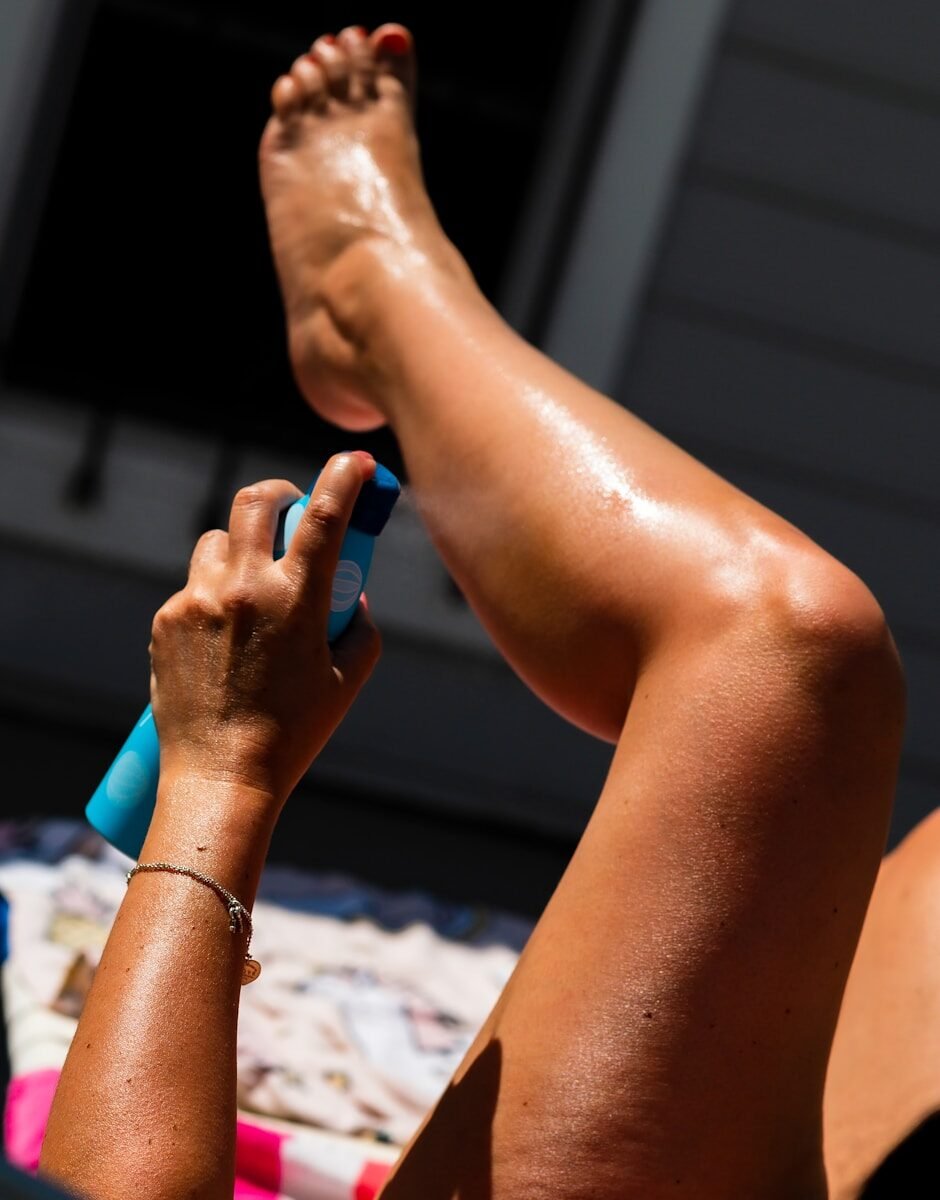
For face application, do not spray aerosols directly on your face. Spray the product into your palm and apply with your hand, avoiding the eye area and lips. For children, the adult applies product to their own hands first and then transfers it to the child’s skin. Repellent goes over clothing on fabric that may be tight against the skin — mosquitoes can bite through thin, form-fitting fabric. Loose-fitting long sleeves and pants treated with permethrin provide a meaningfully higher protection level than skin repellent alone. Sawyer’s Permethrin clothing spray is the product most commonly recommended for clothing treatment and pairs directly with their picaridin skin repellent.
One practical note on sunscreen layering that Consumer Reports flags: apply sunscreen first, let it absorb, then apply repellent on top. Do not use combination sunscreen-repellent products — sunscreen requires reapplication every two hours, but repellent should not be reapplied that frequently, and following the sunscreen schedule would over-expose skin to the repellent’s active ingredient unnecessarily.
Our Recommended Products
Sawyer Products SP544 20% Picaridin Premium Pump Spray — The Best All-Around Repellent
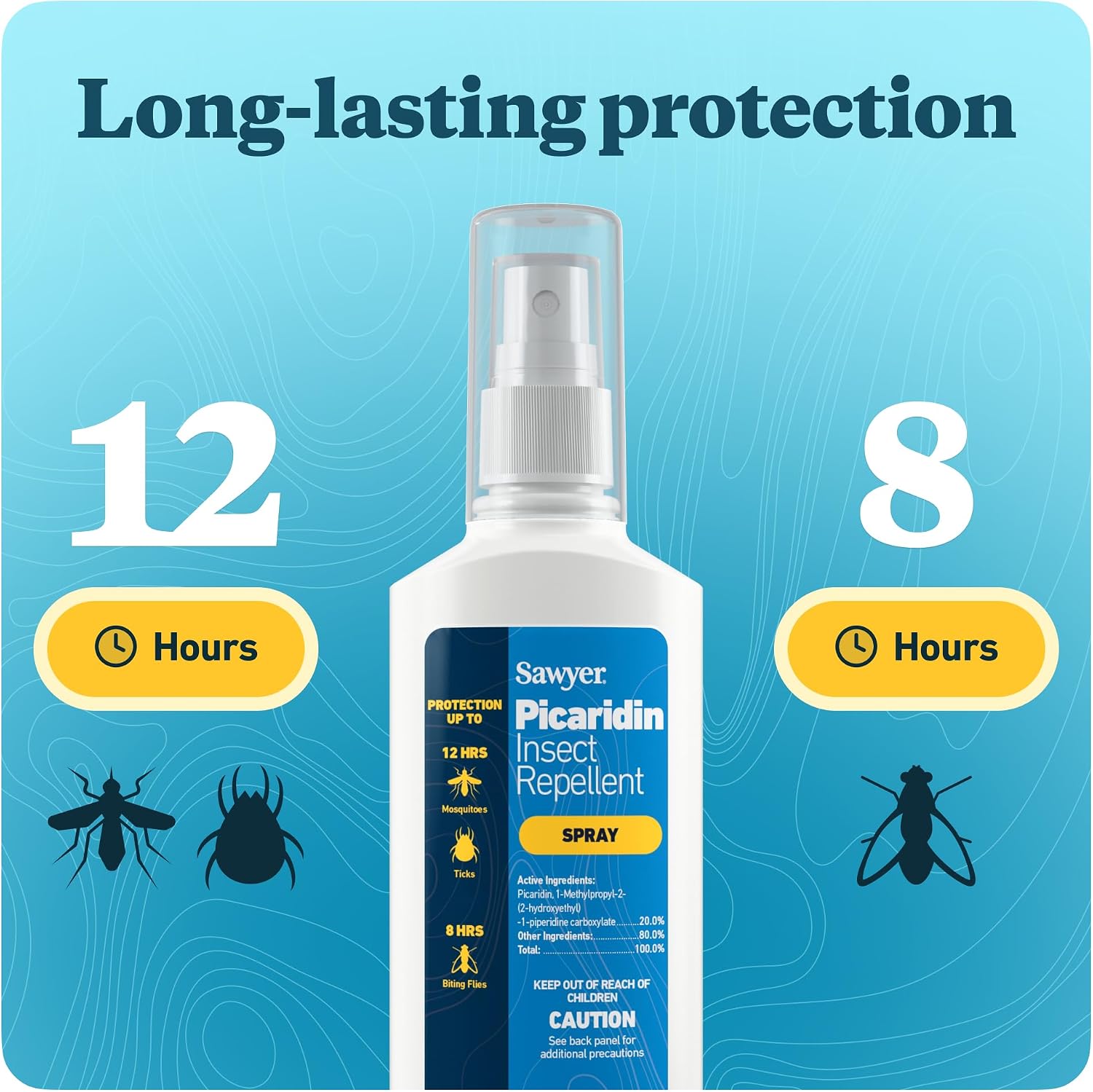
Sawyer’s 20% Picaridin is the repellent I hand to people who ask me what to buy and don’t want a long explanation. It’s been named a top pick by the New York Times Wirecutter, Consumer Reports has included it in their recommended repellents list, and the World Health Organization’s endorsement of picaridin as its preferred active ingredient for malaria prevention is about as strong an external validation as exists in this category. The 4-ounce pump spray format is airline-approved for carry-on bags, and the lockable spray nozzle prevents leaking in a pack pocket — a small design detail that adds up over a hiking season. Up to 12 hours of protection against mosquitoes and ticks, up to 8 hours against biting flies, gnats, and sand flies.
The practical on-skin experience is genuinely different from DEET-based products. No odor that registers once dry. Completely non-greasy — it absorbs in seconds and the skin feels normal, not coated. It won’t damage the sunglasses, watch, or synthetic fabrics it contacts. I’ve applied it to camera straps, backpack hip belts, and watch bands without issue. These aren’t minor conveniences — over the course of a summer of outdoor use they’re the difference between reaching for the repellent consistently and avoiding it because you don’t want to deal with the residue.
Sawyer also sells this product in a lotion format, which provides up to 14 hours of protection against mosquitoes and ticks — longer than the spray version. The lotion format is specifically recommended for situations where sweating is expected: running, cycling, paddling. The oil-based lotion vehicle binds more durably to skin than an alcohol-carrier spray, maintaining the active ingredient concentration longer under perspiration. For high-output activities, the lotion is worth carrying instead of or alongside the spray.
Best for: families with children (2 months and up), outdoor enthusiasts who use optics, watches, and synthetic clothing, travelers who want airline-compliant sizing, anyone who has avoided repellent because of DEET’s smell or feel, and the default recommendation for anyone who asks what to buy and wants one answer.
OFF! Deep Woods Dry 25% DEET Aerosol — The Field-Proven DEET Standard

OFF! Deep Woods has been the default mosquito repellent for American outdoors use for decades, and the “Dry” formulation specifically addresses the texture complaint that has historically been DEET’s main consumer disadvantage. It applies as a fine aerosol mist that goes on dry, absorbs quickly, and doesn’t leave the tacky, oily surface feel of older DEET formulations. At 25% DEET it provides up to 8 hours of protection against mosquitoes and ticks. The aerosol format covers skin surface quickly — full-arm application in a few seconds — which matters for kids who won’t hold still or any situation where you need to apply fast before heading outdoors.
The aerosol spray pattern is wide and consistent, which makes it harder to miss skin patches than a pump spray with a narrower stream. This is particularly relevant for applying to the back of the neck and other awkward areas. It repels mosquitoes carrying Zika, West Nile, dengue, and chikungunya, plus ticks, biting flies, gnats, and chiggers. The protective chemistry is as well-understood as anything in this category — 80 years of safety research sits behind DEET, and at 25% it represents the concentration range that EPA, CDC, and Consumer Reports all converge on as the sweet spot for efficacy and safety.
Two honest limitations: DEET will damage plastics, watch crystals, synthetic fabrics, and painted surfaces, so be deliberate about where spray drifts. And the aerosol format cannot legally go in airline carry-on bags — for travel, the Sawyer picaridin pump spray or a 3.4-ounce or smaller DEET pump spray is the appropriate format. Keep a can of OFF! Deep Woods at the cabin, in the truck, or at the trailhead. Use the pocket-size pump versions for travel.
Best for: camping and cabin trips, fishing and hunting, high-mosquito environments where rapid all-over application matters, anyone who prefers the longest-tested active ingredient in the category, and situations where the plastic-damage limitation of DEET is not a concern.
Cutter Backwoods Dry 25% DEET Aerosol — The Budget DEET Pick That Outperforms Its Price

Cutter Backwoods has existed in essentially this formulation for generations and earned a following among hunters, anglers, and anyone who spends serious time in high-insect conditions. In CNN Underscored’s most recent hands-on comparison of 19 repellents, Cutter Backwoods Dry edged out OFF! Deep Woods as the top-performing DEET spray specifically because of its delivery mechanism: the nozzle sprays upside down, which is genuinely useful for applying to the back of legs, under pant cuffs, and other positions where most aerosol cans stop working. The nozzle also has a protective cap that prevents clogging — a small feature that extends the practical life of a repellent can significantly.
At 25% DEET it claims up to 10 hours of protection, one hour longer than the OFF! Deep Woods claim, and the sweat-resistant formula performs well under active conditions. Like all DEET aerosols, it covers skin fast, repels the full suite of problem insects — mosquitoes, ticks, biting flies, gnats, no-see-ums, chiggers, fleas — and carries the EPA registration and CDC active ingredient recommendation that validates it for disease prevention. Cutter’s formulation history goes back more than 50 years; this is not a no-name product hoping DEET does all the work. The base formula has been refined continuously over that period.
If cost is a factor — and for households buying multiple cans for a summer’s outdoor season, cost adds up — the Cutter Backwoods Dry consistently costs less than the comparable OFF! Deep Woods while delivering equivalent performance. Buy a 3-pack for the price of one premium-tier product and keep one in the car, one in the gear bag, and one at the back door. Repellent you have with you beats repellent you left at home because you were trying to minimize how many bottles you carry.
Best for: budget-conscious families buying in quantity for summer outdoor use, hunters and anglers in high-insect conditions, active users who need upside-down spray capability, and anyone who wants solid DEET performance without premium brand pricing.
Repel Plant-Based Lemon Eucalyptus 30% OLE Pump Spray — The Best Non-DEET / Non-Picaridin Option

This is the only product on this list where the “plant-based” claim is substantively true and relevant rather than marketing language. Oil of lemon eucalyptus is derived from the Eucalyptus citriodora tree, is EPA-registered, and is one of a small handful of active ingredients the CDC specifically endorses for prevention of mosquito-borne disease. At 30% concentration — roughly 65% of which is the active component para-menthane-diol — it provides up to six hours of protection against mosquitoes. That’s shorter than the 8–12 hours of DEET or picaridin, but it’s six times longer than any citronella product I’ve tested and ten times longer than most essential oil blends in the Consumer Reports data.
Repel’s OLE formulation goes on clear, non-greasy, and dries to a faintly eucalyptus-scented finish that most users find far more pleasant than DEET’s chemical odor. It won’t damage plastics or synthetics. The pump spray format delivers a consistent mist that’s controllable around the face — dispense into your palm and apply to facial skin rather than spraying directly on the face. At 30% OLE it should not be used on children under 3, which distinguishes it from DEET and picaridin products approved from 2 months.
The limitation worth stating clearly: if you’re in a high-risk disease area, or spending extended time outdoors without access to reapplication, the shorter protection window of OLE makes it a less robust choice than 25% DEET or 20% picaridin. For backyard evenings, neighborhood walks, or day hikes where you can reapply mid-activity, it’s a legitimate and comfortable option. For anyone who has tried and rejected DEET and picaridin but wants real protection rather than false comfort from citronella, OLE is the answer. The distinction between genuine plant-derived repellent efficacy (this product) and wishful botanical marketing (everything else labeled “natural”) matters and is worth understanding before buying.
Best for: adults and children 3 and older who prefer to avoid synthetic active ingredients, backyard and light outdoor use where reapplication every 5–6 hours is feasible, travel destinations where disease risk is moderate rather than high, and anyone specifically seeking CDC-endorsed plant-derived protection.
Our Verdict
The buying decision on mosquito repellent is simpler than the market makes it look, once you accept the foundational rule: only EPA-registered active ingredients work, and of those, only DEET at 20–30%, picaridin at 20%, OLE at 30%, and IR3535 at 20% are CDC-endorsed for disease prevention. Everything else is a purchase based on preference for the packaging, not evidence of protection.
The counter-intuitive truth about this category is that “natural” is not a meaningful safety advantage over the recommended synthetic options — it’s often a safety disadvantage, because a product that fails to repel leaves the user unprotected. DEET has been used billions of times with a safety record that’s been more rigorously established than most ingredients in any consumer product category. Picaridin has been in widespread use for 25 years in Europe and Australia and has a safety profile comparable to DEET with a better user experience. The question isn’t whether to use registered active ingredients — it’s which one you find most comfortable to use consistently, because consistent use of an effective repellent is what determines whether you get bitten.
If you’re building out a full outdoor protection kit for summer, repellent is the body layer. Permethrin-treated clothing adds a second layer that protects areas the skin spray doesn’t reach and continues working even after the skin formulation wears off. Eliminating standing water within 100 feet of where you spend time — bird baths, low spots in the yard, clogged gutters, buckets — eliminates breeding habitat. The CDC estimates that a single water-filled container the size of a jar lid can produce hundreds of mosquitoes per week. Outdoor comfort is a system, not a single product. For yards where automated equipment plays a role in backyard maintenance — and reducing standing water in hard-to-reach areas is part of that — the approach described in our guide to the best robotic pool cleaners illustrates the same principle of consistent maintenance applied to water features. And for anyone spending serious outdoor time in conditions that also affect physical recovery and sleep quality, our coverage of the best weighted blankets for sleep and comfort is worth a look alongside your outdoor preparation checklist.
The repellents recommended here — Sawyer Picaridin, OFF! Deep Woods, Cutter Backwoods, and Repel OLE — cover every situation from family backyard use to backcountry camping to travel. Pick the one that fits your skin chemistry, your use case, and your comfort level with the active ingredient. Use it as directed. Wash it off when you come inside. That’s genuinely all there is to it.
Repellent Selection Guide by Situation
| Situation | Best Pick | Active Ingredient | Key Reason | One Limitation |
|---|---|---|---|---|
| Family backyard use with young children | Sawyer 20% Picaridin | Picaridin | No odor, safe 2 months+, no plastic damage | Shorter shelf life once opened |
| Camping and backcountry hiking | OFF! Deep Woods Dry or Cutter Backwoods | DEET 25% | Up to 8–10 hrs; widest insect coverage | Damages plastics; not airline carry-on safe |
| Fishing, hunting, heavy sweat activity | Cutter Backwoods Dry | DEET 25% | Sweat-resistant; upside-down spray; budget pack | DEET plastic-damage caution applies |
| Air travel and international destinations | Sawyer 20% Picaridin pump (3–4 oz) | Picaridin | TSA-compliant; WHO-endorsed for malaria prevention | Reapply after swimming or heavy sweating |
| Backyard evening use, DEET-avoiders | Repel Plant-Based Lemon Eucalyptus | OLE 30% | CDC-endorsed; pleasant scent; EPA-registered | Not for under-3; 6-hr limit; pungent eucalyptus scent |
| High-risk disease region travel | Sawyer 20% Picaridin or DEET 25–30% | Picaridin or DEET | Longest protection; WHO/CDC top-tier recommendation | Consult a travel medicine physician for endemic regions |
Frequently Asked Questions
What is the most effective outdoor mosquito repellent?
The CDC recommends EPA-registered repellents containing DEET at 20–30%, picaridin at 20%, IR3535 at 20%, or oil of lemon eucalyptus (OLE) at 30% as the most effective options for preventing mosquito bites. DEET at 25–30% and picaridin at 20% provide the longest protection — typically 8 to 12 hours — and are independently verified through Consumer Reports and laboratory testing. Natural essential oil-based repellents using citronella, lavender, peppermint, or similar ingredients are not EPA-registered for efficacy and consistently fail in independent testing, often providing under one hour of protection. The EPA’s repellent search tool lets you verify any product’s registered claims before buying.
Is DEET safe to use?
Yes, when used as directed. DEET has undergone multiple comprehensive safety reviews by the EPA, which concludes it does not present a health concern to the general population including children when applied per label instructions. The CDC and Environmental Working Group both report that DEET is safer than many consumers assume. Key precautions: do not use on infants under 2 months, avoid contact with eyes and mouth, apply to exposed skin only, do not allow children to apply it themselves, and wash treated skin with soap and water when returning indoors. DEET concentrations above 30% are not recommended for routine use — the safety and efficacy data fully supports 20–30% for most adult and child applications.
Is picaridin better than DEET?
For mosquito and tick protection, picaridin at 20% and DEET at 25–30% perform at roughly equivalent levels in independent testing — both providing 8 to 12 hours of coverage. Picaridin outperforms DEET against biting flies and has practical advantages: no meaningful odor, no damage to plastics or synthetic materials, and lower skin irritation potential. DEET has a longer field history and is slightly more available in smaller towns and rural stores. The choice usually comes down to personal preference. If you dislike DEET’s smell or its impact on gear, picaridin at 20% is the direct functional replacement.
Can I use mosquito repellent on children?
Yes, following age guidelines. Do not use any insect repellent on infants under 2 months old. For children 2 months and older, products containing DEET, picaridin, or IR3535 are safe per label directions. Oil of lemon eucalyptus should not be used on children under 3 years. Adults should apply repellent to their own hands first and apply to the child’s skin — do not let children handle repellent bottles. Avoid applying to hands, around eyes, near mouth, or on cuts or irritated skin. The EWG recommends DEET below 30% or picaridin at 10–20% for children.
How long does mosquito repellent last?
Protection duration depends on active ingredient and concentration. DEET at 25–30% typically provides 6–8 hours. Picaridin at 20% provides up to 12 hours as a spray and up to 14 hours as a lotion against mosquitoes. OLE at 30% provides approximately 6 hours. IR3535 at 20% provides up to 8 hours. All of these durations decrease when sweating heavily, swimming, or wiping skin — reapply sooner in these conditions. The stated protection time assumes normal activity and application to clean, dry skin; real-world duration under strenuous outdoor activity is typically 75–90% of the labeled claim.
Should I apply sunscreen or mosquito repellent first?
Apply sunscreen first, allow it to absorb, then apply mosquito repellent on top. Consumer Reports and the CDC both advise against combination sunscreen-repellent products because sunscreen requires reapplication every 2 hours while repellent active ingredients should not be reapplied at that frequency — doing so would result in over-exposure to the repellent chemistry. Use separate products, apply in the correct sequence, and reapply sunscreen on its own schedule without adding more repellent unless the repellent’s stated duration has genuinely elapsed.
Do natural mosquito repellents work?
Essential oil-based natural repellents — citronella, peppermint, lemongrass, cedar, lavender, clove, soybean — are not EPA-registered for efficacy and fail consistently in independent testing by Consumer Reports, typically providing less than one hour of protection. Oil of lemon eucalyptus is the important exception: it is plant-derived, EPA-registered, and CDC-recommended, and provides genuine 6-hour protection. Do not confuse OLE-containing registered repellents like Repel’s Plant-Based Lemon Eucalyptus with unregulated eucalyptus essential oil products — they are different formulations with very different performance outcomes. If plant-derived protection is important to you, OLE at 30% is the only option with an evidence base that justifies the claim.