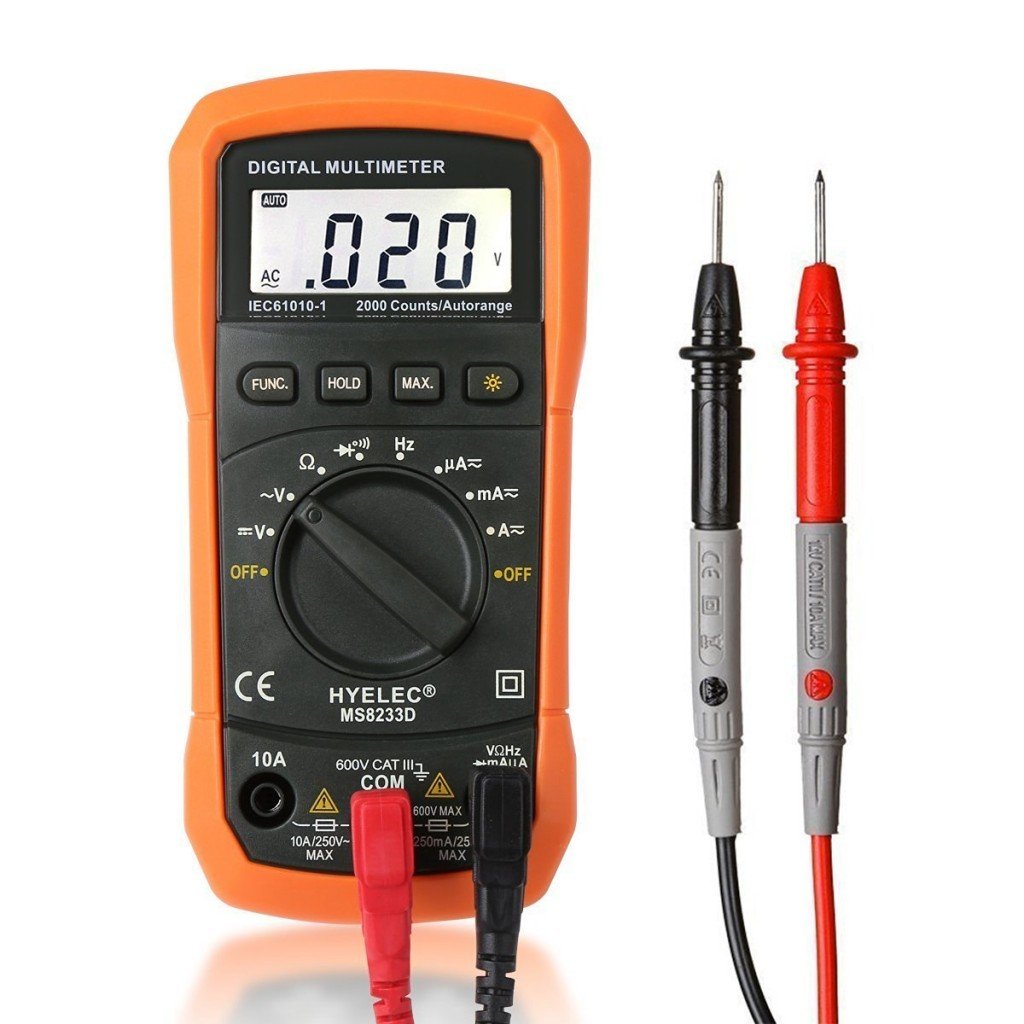
Digital Clamp Meter vs Digital Multimeter — A Plain-Language Guide for Every Skill Level
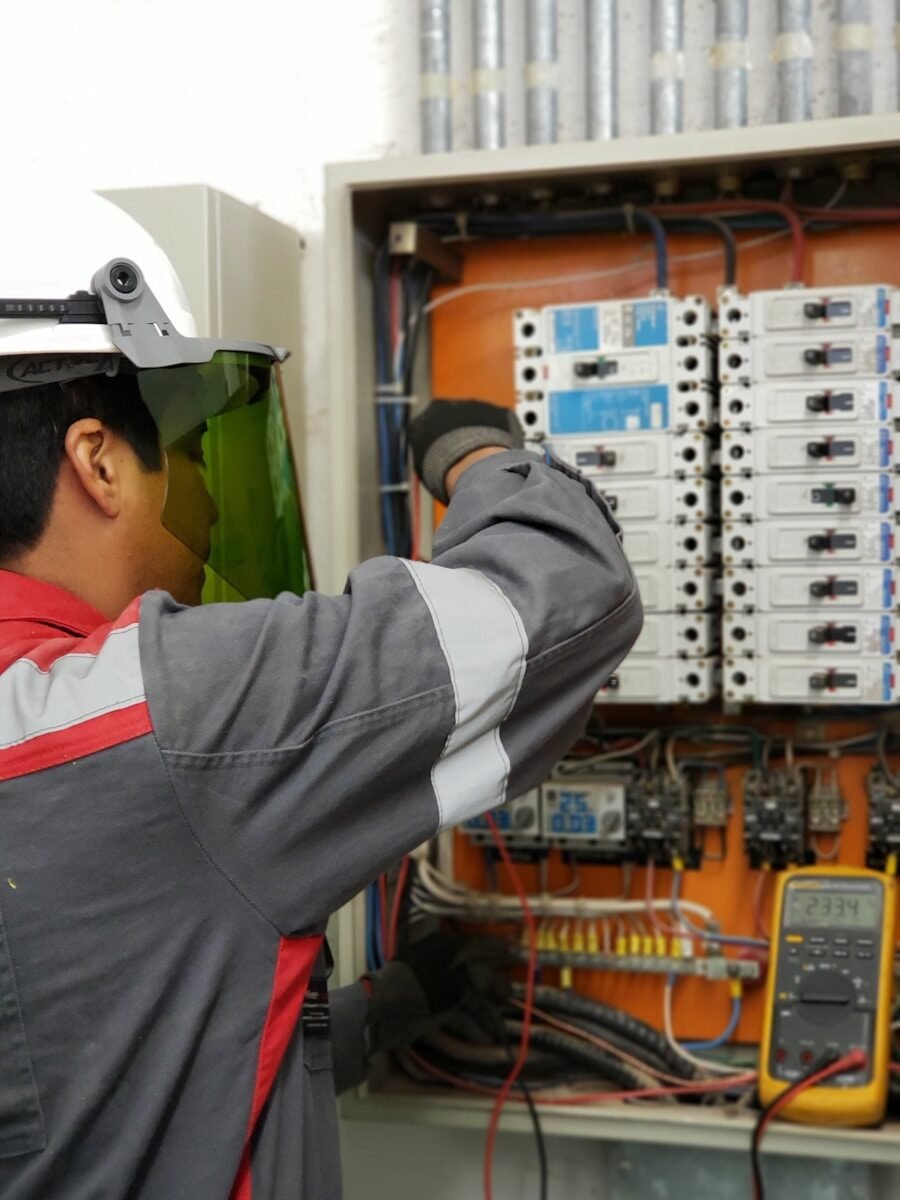
I own both. I’ve owned both for years, and I still reach for the wrong one sometimes — not often, but it happens when I’m in a hurry and grab whatever’s closer. The clamp meter gets picked up for panel work and HVAC diagnostics. The multimeter comes out when I’m poking around a circuit board, checking a sensor, or need a resistance reading precise enough to matter. They’re not interchangeable in the situations where precision counts. Most guides I’ve read treat this as a straightforward either/or question, but the honest answer is more nuanced: both tools have genuine advantages, and understanding the boundary between them tells you a lot about what you actually need to buy.
The question I get most often from people setting up their first proper tool kit is whether a clamp meter “replaces” a multimeter or vice versa. The short answer is: partly. A modern clamp meter with test lead ports handles the majority of what a basic multimeter does. But the specific jobs where a multimeter is irreplaceable — millivolt-level voltage measurements, milliamp current in low-power circuits, precise resistance in the ohm and milliohm range — are exactly the jobs where a clamp meter falls short. If your work is exclusively on building electrical systems and HVAC, a clamp meter may genuinely be all you need. If it touches electronics, automotive diagnostics, or component-level troubleshooting in any form, you need a DMM as well.
This guide covers the real technical distinctions, the safety standards that should govern which meter you choose for which environment, and the specific products worth buying at three price points across both categories.
Quick Comparison: Digital Clamp Meter vs Multimeter
| Feature | Digital Clamp Meter | Digital Multimeter (DMM) |
|---|---|---|
| Primary function | Current measurement without breaking circuit | Precise voltage, resistance, and current measurement |
| How current is measured | Inductive clamp jaw around conductor — no contact needed | Test probes in series — circuit must be broken |
| Current range | Typically 100A–600A (some up to 1000A+) | Typically 10A or 20A max via probes |
| Measurement resolution | Tenths or hundredths of a unit | Millivolts, milliamps, milliohms available |
| Safety on live circuits | Safer — no need to touch energized conductors for current | Probe contact required; correct CAT rating essential |
| Best for | Electricians, HVAC, panel work, feeders, load balancing | Electronics, automotive, component testing, homeowners |
| Measures voltage? | Yes (via test lead ports on most modern models) | Yes — core function |
| Measures resistance? | Yes (via test leads) — limited low-end resolution | Yes — down to milliohm range on quality models |
| Price range | $30–$300+ (quality starts around $60–$80) | $15–$500+ (reliable quality from $20–$30) |
How Each Tool Actually Measures Current — and Why It Matters
The fundamental distinction between these tools isn’t brand or price — it’s physics. A clamp meter measures current using electromagnetic induction. When alternating current flows through a conductor, it generates a magnetic field that changes in proportion to the current. The clamp meter’s jaws form a transformer core that detects this field and converts it to a reading. For DC current measurement, better clamp meters use a Hall Effect sensor inside the jaw, which detects static magnetic fields rather than changing ones. The critical result in either case: the circuit is never interrupted. You clamp around the wire and read the current — as simple as measuring the diameter of a pipe by wrapping a gauge around it.
A multimeter measures current the old-fashioned way: by physically inserting itself into the circuit path and measuring the current flowing through its own shunt resistor. This is accurate and can detect tiny currents — useful for electronics where you’re characterizing microamp standby draws or milliamp LED currents — but it requires physically breaking the circuit, connecting the meter in series, and making probe contact with conductors that may be energized. On household circuits and panels, that’s manageable with proper technique. On 3-phase industrial feeders or service entrance equipment, that requirement to break the circuit and make probe contact is where risk concentrates.
This is why Fluke, the instrument industry’s reference-standard brand, describes the distinction plainly on their own educational resources: a multimeter is fundamentally a voltage-measuring device with current capabilities, while a clamp meter is fundamentally a current-measuring device with voltage capabilities. The tools overlap in the middle but are optimized at opposite ends of the measurement spectrum.
CAT Ratings: The Safety Spec That Most Buyers Skip
The most important number on any electrical test instrument isn’t the voltage range or the count display — it’s the CAT rating. CAT ratings are defined by the international standard IEC 61010 and describe the overvoltage environment for which a meter is designed to protect its user during a transient event. Electrical transients — voltage spikes caused by switching, lightning, or inductive kickback — can reach thousands of volts for microseconds even on a 120V circuit. A meter that fails during a transient in an uncontrolled way can arc, explode, or send a current through the user. A properly rated meter fails in a controlled, safe manner.
CAT II covers the outlets, appliance cords, and receptacles in a home — appropriate for a homeowner testing a wall outlet or a battery charger. CAT III covers 3-phase building wiring, distribution panels, and industrial switchgear — what electricians and HVAC technicians encounter daily. CAT IV covers the utility service entry point, outdoor wiring, and the meter base — the highest-risk zone where fault current and transient energy are greatest. The OSHA electrical safety standards and the NFPA 70E standard for electrical safety in the workplace both address the proper use of test equipment rated for the hazard environment. Using a CAT II-rated meter in a CAT III or CAT IV environment is not a minor compromise — it’s a safety failure.
“A digital multimeter is essentially a voltage-measuring tool with some current abilities. A clamp meter is basically a current-measuring tool with some voltage abilities. They are distinctly different instruments, each with its own advantages.” — Fluke Corporation Technical Resources
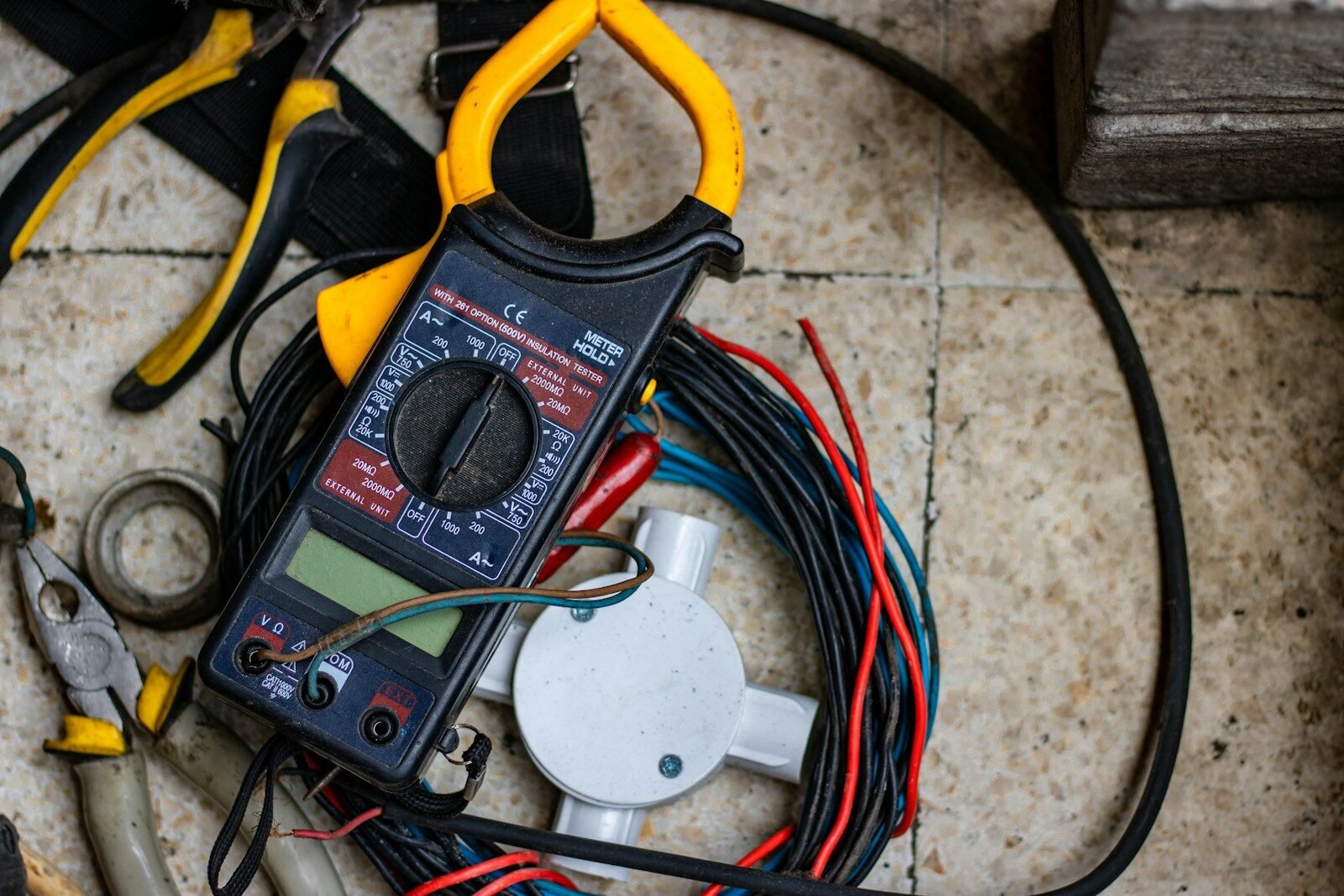
True RMS: The Measurement Standard That Matters on Modern Circuits
A non-True-RMS meter assumes it’s measuring a pure sine wave. In a 1970s building with incandescent lighting and resistive loads, that assumption was approximately correct. In a modern building with LED drivers, variable frequency drives on HVAC motors, switching power supplies in servers and computers, and variable-speed compressors, the AC waveform is anything but sinusoidal. These loads distort the waveform in ways that cause an average-responding meter to read significantly low — the error can exceed 40% on highly distorted circuits. A True RMS meter calculates the actual heating value of the current regardless of waveform shape, producing a reading that reflects the real power being delivered.
True RMS is not a premium feature anymore — it’s a baseline requirement for any meter that will be used on modern electrical systems. Both the Klein Tools CL800 and the Fluke 115 reviewed below are True RMS instruments. The AstroAI AM33D is a budget option that does not feature True RMS and is explicitly suited for resistive loads, battery testing, and household outlet diagnostics where waveform distortion is not a concern. Know what you’re buying and what you’ll use it for.
When You Need a Clamp Meter — and When You Don’t
The clamp meter’s irreplaceable use case is measuring current in a conductor you cannot or should not interrupt. Service panel work is the clearest example. A licensed electrician verifying that three phases on a commercial feeder are balanced can clamp around each phase conductor in turn and read the current without shutting anything down. Residential HVAC troubleshooting is another: clamping around a compressor lead to verify running current and compare it to the nameplate RLA (Rated Load Amps) tells you immediately whether the compressor is drawing correctly — something you cannot do safely with a DMM in that environment without very deliberate probe placement on energized terminals.
The clamp meter’s meaningful limitation is resolution. Because it measures through electromagnetic induction rather than direct probe contact, the minimum detectable current is typically in the 0.1A range. A 50mA standby draw on a circuit board is invisible to a standard clamp meter. A 1mA automotive key-off draw — a common diagnostic target when checking for parasitic drain on a car battery — is also beyond most clamp meters without a specialized low-current flex probe. For those measurements, a DMM is the tool. Automotive diagnostics in particular lend themselves to DMM use: measuring battery voltage under load, checking alternator output voltage, verifying sensor reference voltages at 5V or lower, testing resistance in ground paths. If you also work on your vehicles, a DMM is the instrument that handles those jobs.
For a look at how connected diagnostic tools work on the automotive side, our guide to what an OBD2 scanner does and when to use one covers the vehicle-side diagnostic tool that complements a multimeter for anyone who works on their own car alongside home electrical systems.
The Display Count Question — What 2000 vs 6000 Counts Actually Means
Meter display counts describe the resolution of the reading: a 2000-count meter can display readings from 0 to 1999 in a given range, while a 6000-count meter displays 0 to 5999. The practical effect is that a 6000-count meter shows finer gradations within a measurement range. On a 200V range, a 2000-count meter resolves to the nearest 0.1V, while a 6000-count meter resolves to the nearest 0.033V. For voltage work on building circuits, 2000 counts is often sufficient. For electronics diagnostics where you’re characterizing a 3.3V logic supply or a 1.8V rail, 6000 counts provides meaningfully better information.
The KAIWEETS KC601/KC602 clamp meter reviewed below offers 6000 counts — above average for a clamp meter in its price range, where 4000 counts is more typical. The Fluke 115 DMM offers 6000 counts and the True RMS engine to use them accurately. The AstroAI AM33D is a 2000-count meter — appropriate for its target use cases but not for precision electronics work. Match the count resolution to the precision your work actually requires rather than buying resolution you’ll never need.
Jaw Size and What It Limits
A clamp meter’s jaw opening determines the conductor diameter it can wrap around. Standard clamp meters open to about 1.5 inches (approximately 38mm) — sufficient for individual conductors and most residential feeders up to about 350kcmil. Larger industrial conductors, cable bundles, and bus bars require flexible clamp adapters (also called iFlex or Rogowski coils) that loop around the conductor rather than rigid jaws that must encircle it. The Klein Tools CL800 uses a rigid jaw sized for standard conductors. If your work involves large service conductors or bundled cables, verify jaw capacity before purchasing a clamp meter, or look specifically for a model with flex probe compatibility.
A subtler limitation: you must clamp around a single conductor to get an accurate reading. Clamping around a two-conductor cable — where the hot and neutral are together inside the jacket — produces a reading of near zero because the currents are equal and opposite, canceling each other out magnetically. This is a common beginner mistake. When measuring household circuits, you must either clamp the individual conductors inside a junction box or use a line splitter accessory that separates the conductors to allow a single-wire clamp reading.
Our Recommended Products
Klein Tools CL800 — The Professional Clamp Meter Built for Electricians

Klein Tools has been making hand tools for American tradespeople for over 160 years, and the CL800 is built to the standard their reputation demands. It’s a True RMS auto-ranging clamp meter that measures AC and DC current via the jaw (up to 600A), and AC/DC voltage, resistance, continuity, frequency, capacitance, and diode test via test leads. Temperature measurement is included via the thermocouple probe in the package. The Low Impedance (LoZ) mode identifies ghost voltages — phantom readings on de-energized circuits caused by capacitive coupling from adjacent live circuits — and eliminates them, which is a specific and genuinely useful feature for anyone regularly troubleshooting building wiring.
The physical design is clearly aimed at professional electricians rather than occasional users. It carries IP40 ingress protection and a 6.6-foot (2m) drop rating — tested, not aspirational — along with an integrated worklight for reading in dim panels and an integrated test lead holder on the body so probes don’t disappear into a bag. CAT III 600V / CAT IV 300V safety ratings mean it’s appropriate for panel work, 3-phase distribution, and building feeders. The included carrying case, thermocouple probe, and test leads are quality components, not afterthoughts.
What the CL800 is not: it’s not a precision electronics instrument. Resolution is in tenths and hundredths, appropriate for electrical trade work but not for characterizing sensor voltages or tracking component-level behavior. Minimum clamp current sensitivity is 0.1A — milliamp measurement is off the table. And like all clamp meters, it requires a single exposed conductor; multi-conductor cables require opening a junction box or using a line splitter to get usable readings.
Best for: licensed electricians, HVAC technicians, industrial maintenance professionals, and serious DIYers who regularly work on residential panels, 3-phase feeders, or HVAC equipment. If current measurement on live systems is a routine part of the job, this is the tool to own.
Fluke 115 — The Field Technician’s DMM Benchmark

Fluke is the instrument brand that professionals in every electrical trade use as a reference. The 115 is not their most capable DMM — the 87V and 289 sit above it — but it’s the compact, field-ready instrument that covers the full range of measurement tasks most technicians encounter daily without unnecessary complexity. True RMS voltage and current, 6000-count display, continuity, resistance, frequency, capacitance, and diode test are all present. The large white LED backlight is genuinely useful in dark panels and equipment rooms. Auto-ranging simplifies rapid sequential measurements across different circuit types.
CAT III 600V independently tested and certified. That’s not a marketing claim — Fluke submits meters to independent testing laboratories, and the 115 carries certification from those labs. The difference between a meter with a self-declared CAT III rating and one with an independently verified one is significant in practice; transient energy handling is what separates a safe failure from an arc flash incident. The fusing on the 115 is HRC (High Rupturing Capacity) — a meaningful safety feature on the current input path that budget meters frequently skip.
What you give up at the 115’s price point compared to higher Fluke models: no Min/Max recording, no data logging, no thermometer input, no inrush current function. It’s a precision measurement instrument, not a diagnostic system. For field technicians who need the diagnostic features — particularly logging for intermittent faults — the 87V is worth the premium. For most work that involves accurate, reliable voltage and continuity measurements on field equipment, the 115 is the instrument to reach for.
Best for: field service technicians, industrial maintenance electricians, commercial HVAC professionals who need accurate measurements on distorted waveforms, and anyone who wants a professional-grade DMM that will last decades with proper care.
AstroAI AM33D — The Reliable Budget DMM for Homeowners and DIYers

The AstroAI AM33D is consistently among the top-ranked multimeters on Amazon and carries over 40,000 verified reviews with a sustained 4.5-star rating — the kind of track record that reflects actual utility in real-world use rather than launch momentum. It’s a 2000-count manual-ranging DMM that measures AC/DC voltage, DC current, resistance, continuity, and diode test. No True RMS. No auto-ranging. No capacitance or frequency. For the jobs it’s designed for — outlet testing, battery voltage, automotive circuit checking, household continuity work — it performs accurately and reliably.
The manual ranging means you select the measurement range yourself rather than having the meter auto-select. For someone measuring household outlets (120V), that means selecting the 200V AC range. It’s not difficult once you’ve done it twice, but it’s an extra step compared to an auto-ranging meter, and it increases the risk of blowing the ammeter fuse if you accidentally try to measure current while the meter is set to a voltage range. Read the instructions the first time.
The AM33D lacks True RMS and is therefore not appropriate for work on circuits with significant harmonic distortion — meaning any circuit loaded with variable-speed drives, LED dimmers, or switching power supplies where you need an accurate picture of actual power consumption. For a homeowner checking whether an outlet is live, testing a car battery, or verifying a fuse is intact, that limitation is irrelevant. The AM33D comes with a 9V battery, two test leads, and a one-year warranty. At its price point, it’s the most honest choice for exactly what it is: an entry-level tool that does its specific jobs well.
Best for: homeowners doing basic electrical maintenance, automotive hobbyists testing batteries and circuits, students learning electrical fundamentals, and anyone wanting a reliable backup meter without significant investment.
KAIWEETS Smart Clamp Meter — The Feature-Rich Mid-Range Pick

KAIWEETS has built a credible reputation in the mid-range measurement tool market by packing legitimate features into accessible price points, and the smart meter makes a strong case for buyers who want more than a basic clamp but can’t justify the Klein or Fluke price tier. The key differentiators: a full-color HD display that shows measurement type and value simultaneously with better contrast than the monochrome LCDs on most competitors, an intelligent auto-mode that automatically identifies whether you’re measuring voltage, current, or resistance and selects the appropriate range without turning a dial, an inrush current capture function, and AC/DC current measurement. CAT III 600V certification is present.
The 6000-count display gives this meter better resolution than the 2000-count and 4000-count instruments that dominate its price band. The D-shaped jaw design is a practical improvement over round-profile clamps: it positions test leads in a notch on the body rather than loose in a pocket, and the profile makes it easier to orient the clamp in cramped panel boxes. Temperature measurement is included via thermocouple, the NCV (non-contact voltage) indicator on the jaw lets you check for live conductors before clamping, and the auto-off function saves the batteries when you set the meter down mid-job.
KAIWEETS provides a 36-month warranty on this product, which is meaningfully longer than the one-year coverage typical in this price range, and their customer service response record on Amazon reviews is notably active. The inrush current function is the feature that specifically earns this meter’s place in an HVAC technician’s kit — capturing the startup current spike on a compressor or motor tells you whether the inrush is within specification or indicates a developing fault that running current alone won’t reveal.
Best for: HVAC technicians, electricians looking for a capable second meter at a lower investment than Fluke or Klein, advanced DIYers who work on their own HVAC systems, and any buyer who wants inrush current capture, color display, and True RMS in a single affordable instrument.
Our Verdict
Here’s the thing most clamp meter vs multimeter articles get wrong: they argue for one tool as though the other doesn’t exist in the same world. Professional electricians carry both. Field technicians carry both. The choice of which to own first — and which to add second — depends on what you’re actually doing, not on abstract capability comparisons.
If you’re a homeowner doing basic maintenance, start with a DMM. The AstroAI AM33D handles outlets, batteries, and continuity at a price that makes the purchase feel low-risk. If you’re a licensed electrician or HVAC tech, a clamp meter like the Klein CL800 handles the current measurement that dominates your daily work, and its test lead ports cover the voltage work. The Fluke 115 belongs on the bench or in the bag of anyone who needs measurements they can genuinely trust on distorted modern circuits — it’s the instrument you reach for when the reading has to be right.
The counter-intuitive truth about this category is that the expensive instrument is often the safer one — not because of brand prestige but because of what the CAT rating and independent certification actually protect you from. A $15 no-name multimeter on a live 200A panel feeder is not a bargain purchase. It’s a safety failure waiting for an occasion. The IEC 61010 standard exists because test instrument failures under transient overvoltage have killed people. The OSHA electrical standards referenced earlier are worth reading in full if you regularly work on energized equipment — understanding the engineering basis for CAT ratings makes it much easier to apply them correctly in the field.
For anyone building out a broader diagnostic toolkit — particularly for vehicle work alongside home electrical systems — the OBD2 scanner is the parallel instrument on the automotive side that a multimeter complements but doesn’t replace. Our breakdown of what an OBD2 scanner does covers that territory in detail. And if you’re doing extended panel or crawlspace work where physical positioning matters, the kind of back support discussed in our guide to the best lower back braces for pain relief is worth thinking about as part of a broader ergonomics kit for trade work.
Finally, the cleaning and maintenance reality that nobody mentions: test leads fail. The insulation cracks, the probe tips corrode, the banana plugs loosen. On a budget meter, the included leads are often the first thing to become unreliable. Replacing leads annually — or immediately if you see any insulation damage — is basic safety practice. Leads rated CAT III 1000V or higher with shrouded connectors are available for under $20 and are worth having as replacements for any meter you use on mains voltages. The meter is rated for the environment. The leads need to be rated for it too.
Buyer’s Guide: Which Meter Fits Your Situation
| Your Situation | Tool to Buy First | Recommended Model | Key Requirement | What to Add Second |
|---|---|---|---|---|
| Homeowner, basic electrical maintenance | DMM | AstroAI AM33D | CAT II 600V minimum | Clamp meter if you want to monitor panel loads |
| Licensed electrician, panel and feeder work | Clamp meter | Klein Tools CL800 | CAT III 600V, True RMS, LoZ mode | Fluke 115 DMM for precision voltage work |
| HVAC technician | Clamp meter | KAIWEETS meter | Inrush current, temperature, AC/DC current, CAT III | Dedicated DMM for control board diagnostics |
| Automotive DIYer | DMM | AstroAI AM33D or Fluke 115 | DC voltage accuracy; milliamp parasitic drain test | OBD2 scanner for code reading |
| Electronics hobbyist / repair technician | DMM | Fluke 115 (or 87V for advanced work) | High count display; millivolt / milliamp resolution | Clamp meter rarely needed in this discipline |
| Building maintenance tech, mixed work | Clamp meter first | KAIWEETS KC601/KC602 or Klein CL800 | AC/DC, True RMS, CAT III, temperature | AstroAI AM33D for low-level circuit checks |
Frequently Asked Questions about Digital Clamp Meter vs Digital Multimeter
What is the main difference between a digital clamp meter and a multimeter?
A digital clamp meter measures current non-invasively by clamping its jaws around a conductor and detecting the magnetic field produced by current flow — no circuit interruption required. A digital multimeter measures current by connecting in series with the circuit via test probes, which requires breaking the circuit. Multimeters provide higher resolution measurements in the millivolt, milliamp, and milliohm range. Clamp meters handle much higher currents safely (typically 100A–600A) without probe contact. Both tools can measure voltage and resistance via test leads; current measurement is where they diverge fundamentally.
Can a clamp meter replace a multimeter?
In electrical trade work — panel work, HVAC, building feeders — a modern clamp meter handles most daily measurement tasks. For electronics repair, automotive diagnostics, or any work requiring millivolt or milliamp precision, a dedicated DMM cannot be replaced. The clamp meter’s current measurement resolution is typically limited to 0.1A or above; a DMM measures current down to microamps. If all of your work is on building electrical systems and HVAC equipment, a clamp meter may be sufficient. If any of it touches electronics or component-level diagnostics, you need both.
What do CAT ratings on meters mean?
CAT ratings defined by IEC 61010 and referenced in OSHA electrical safety standards describe the overvoltage environment for which a meter is rated. CAT II covers receptacles and appliances in a home. CAT III covers 3-phase wiring, distribution panels, and industrial switchgear. CAT IV covers the utility service entrance. A higher rating means the meter safely handles more severe transient voltage spikes. Always use a meter rated at or above the CAT level of your working environment. Using a CAT II meter in a CAT III environment is a safety failure.
What is True RMS and why does it matter?
True RMS is the mathematically accurate method for measuring AC voltage or current on any waveform — pure sine or distorted. Non-True-RMS meters assume a pure sine wave and produce errors of 10–40% on distorted waveforms common in modern buildings with LED lighting, variable-speed drives, and switching power supplies. True RMS meters calculate the actual power-equivalent value regardless of waveform shape. Any meter used on modern commercial or residential electrical systems where switching loads are present should be True RMS. For battery testing and basic continuity at home, it matters less.
What is a good clamp meter for an HVAC technician?
HVAC technicians need AC/DC current, inrush current capture for compressor startups, temperature measurement via thermocouple, and CAT III 600V minimum. The Klein Tools CL800 and KAIWEETS KC601/KC602 both fit this profile. The KAIWEETS adds an inrush function and a color display at a lower price point. The Klein adds proven trade-grade durability and LoZ mode for ghost voltage elimination. Either serves the HVAC diagnostic use case well; the choice comes down to budget and whether the color display and inrush function of the KAIWEETS or the Klein’s build quality and brand support matter more for your specific work environment.
Is a multimeter safe to use on a 240V circuit?
Yes, with the correct instrument. The meter must carry at minimum CAT II 600V for standard household 240V loads (dryer, range), and CAT III 600V for sub-panel or distribution board work. Never use a meter with no CAT rating, a self-declared rating without independent certification, or cheap leads without proper insulation ratings on mains voltages. Fusing on the current input is equally important — HRC fusing (as on the Fluke 115) protects the user if the leads are incorrectly placed in current mode during a voltage measurement. Verify the CAT rating, lead rating, and fusing before taking any reading above 150V.
Should a homeowner buy a clamp meter or a multimeter?
Start with a DMM. A multimeter covers outlet testing, battery voltage, continuity checks on extension cords and switches, automotive battery and charging system testing, and basic fuse verification — the tasks that come up repeatedly in home ownership. A clamp meter adds value if you want to monitor real circuit loads non-invasively, diagnose HVAC issues, or check feeder balance. The AstroAI AM33D handles homeowner DMM tasks reliably. The KAIWEETS KC601/KC602 is a capable first clamp meter if you’re ready to add that capability. For trade professionals, the Klein CL800 and Fluke 115 are the instruments to build a kit around.