Cool Mist vs Warm Mist Humidifier — The Honest Breakdown (and What to Buy)

My house has two humidifiers running most winters, and they are not the same type. One sits in the bedroom — a cool mist ultrasonic that runs silently all night. The other lives in my home office, a compact warm mist vaporizer I reach for specifically when I’m fighting a cold and want that immediate steam-shower sensation while I work. I didn’t arrive at this setup because someone recommended it. I arrived at it after buying the wrong thing twice, cleaning mold out of a tank I’d let go too long, and noticing white dust on the monitor in my office for the better part of a month before I understood what was causing it.
Most articles in this space treat the cool mist vs warm mist question as though there’s a single right answer. There isn’t. The correct answer depends on who’s in the room, how cold it gets where you live, whether you have hard tap water, what your electric bill tolerance is, and whether you’re buying a humidifier to run every night all winter or to pull out when someone gets sick. What I’ll do here is explain the real differences, call out the situations where each type clearly wins, name the health and safety considerations that should actually change your decision, and tell you which specific products to buy on Amazon with verified ASINs I’ve confirmed myself — no guessing.
Quick Comparison: Cool Mist vs Warm Mist Humidifiers at a Glance
| Feature | Cool Mist (Ultrasonic) | Cool Mist (Evaporative) | Warm Mist (Steam Vaporizer) | Dual Mist (Warm + Cool) |
|---|---|---|---|---|
| How it works | Ultrasonic plate vibrates water into fine mist | Fan draws air through wet wick; water evaporates naturally | Boils water; releases as cool-ish steam | PTC heats water; combines with cool mist via atomizer |
| Safe for children? | Yes — no heating element | Yes — no heating element | Caution — hot water burn risk | Safer than traditional warm mist (mist released at 86–120°F) |
| Energy use | Low (25–50 watts) | Low–moderate (15–70 watts) | High (200–400 watts) | Moderate (varies by mode; 280W max) |
| White mineral dust risk? | Yes — use distilled water | No — minerals trapped in wick | No — minerals stay on heating element | Yes (cool mist mode) / No (warm mist mode) |
| Noise level | Near-silent (whisper quiet) | Moderate — fan audible | Quiet (slight boiling/bubbling sound) | Near-silent (<28dB in sleep mode) |
| Room coverage | Small–large (up to 500+ sq ft) | Medium–large (self-regulating) | Small–medium rooms best | Large rooms (up to 753 sq ft) |
| Maintenance | Weekly cleaning; use distilled water | Replace wick filter every 1–3 months | Descale heating element regularly | Weekly cleaning; descale warm mist plate |
How Each Type Actually Works — No Jargon
The fundamental split in how humidifiers work comes down to one question: does water get heated or not? Warm mist models — properly called steam vaporizers — boil the water inside a tank and release the resulting steam into the room. The steam cools slightly before it reaches you, which is why a warm mist humidifier doesn’t fill a room with scalding fog, but the water inside the reservoir is genuinely hot. That boiling process kills bacteria and mold before they can be dispersed — a real advantage from a germ standpoint, but one that comes with the physical burn hazard of having a tank of near-boiling water in your living space.
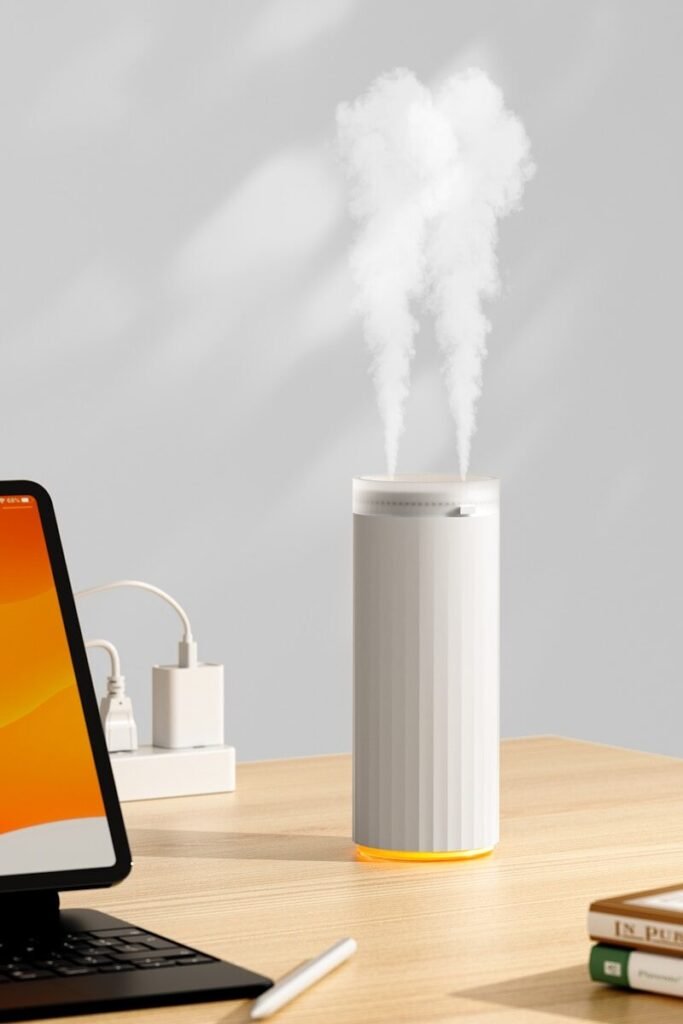
Cool mist splits into two sub-types that behave quite differently in practice. Ultrasonic cool mist uses a ceramic plate vibrating at frequencies in the megahertz range to physically break water into microscopic droplets and expel them as a visible mist. It’s fast, nearly silent, and energy-efficient — but because it doesn’t filter the water, whatever is dissolved in your tap water goes into the air too, including minerals that settle as white dust on furniture and electronics. Evaporative cool mist works the opposite way: a wick filter soaks up water, a fan blows air through the wet wick, and moisture evaporates naturally into the room. The wick captures minerals rather than releasing them. It’s self-regulating — a saturated room simply stops taking up moisture — and it’s the type least likely to over-humidify a space, though the fan produces more noise than an ultrasonic unit.
Dual mist models like the Levoit LV600S use a PTC (positive temperature coefficient) heater to warm water partially, then combine it with cool mist through an atomizing plate. The resulting mist exits at a warm but not scalding temperature — Levoit specifies 86–120°F — which is meaningfully safer than a traditional steam vaporizer while still delivering the faster humidification and bacteria-reduction benefits of heated water.
The Safety Question That Should Change Your Decision
The American Academy of Pediatrics recommends cool mist humidifiers specifically for use in children’s rooms, and this recommendation exists for a direct, practical reason: steam vaporizers contain hot water. If a child or pet tips one over, or reaches the unit and touches the steam outlet, burns can result. This is not a hypothetical concern — the CPSC has recorded burn incidents involving steam vaporizers, and the agency’s guidance on humidifier safety consistently identifies the heating element as the primary physical hazard in the category.
If a child or pet is regularly in the room where a humidifier will run, the decision is straightforward: cool mist, full stop. The ultrasonic models specifically designed for nurseries — like the Pure Enrichment MistAire — are sized, quieted, and designed with exactly this use case in mind. If the humidifier is going in a home office, a closed bedroom used only by adults, or another genuinely child-free space, the warm mist option remains on the table.
“To help reduce the risk of burns, use a cool-mist humidifier rather than a steam vaporizer in a child’s room.” — U.S. Consumer Product Safety Commission
The Energy Cost Difference Is Real and Often Ignored
A warm mist humidifier typically draws between 200 and 400 watts because it has to sustain a rolling boil in its water tank. A cool mist ultrasonic model runs at 25 to 50 watts. That gap sounds abstract until you calculate what it means over a winter of overnight use. Running a 300-watt warm mist unit eight hours a night for 120 days — a reasonable estimate for a cold-climate household — consumes roughly 288 kilowatt-hours. At the U.S. average residential rate of around $0.16 per kWh, that’s about $46 per unit per season. A 40-watt cool mist ultrasonic over the same period costs under $7.
Most households running humidifiers to manage dry winter air will run them nightly from November through March. If you have multiple bedrooms or frequently deal with respiratory issues in winter, the energy difference compounds fast. This doesn’t mean warm mist is never worth it — for the targeted use case of symptom relief during a short illness, the energy cost of a week of warm mist use is negligible. For all-winter, all-night humidity management, cool mist is meaningfully cheaper to run.
What Cold and Flu Season Advice Gets Wrong
There’s a persistent folk wisdom that warm mist is better for colds — that the steam loosens congestion more effectively than cool mist. The truth here is worth paying attention to. The FDA notes that cool mist humidifiers can actually help shrink swelling in nasal passages and make breathing easier during a cold. Consumer Reports has flagged a specific counterintuitive finding: warm mist can cause nasal passages to swell in some users, making breathing more difficult rather than less. The mechanism is that heat expands tissue, and nasal tissue responding to warm air can close up rather than open up in people with significant inflammation.
What a humidifier does in cold and flu season — regardless of type — is maintain adequate moisture in the nasal passages and throat, which reduces irritation, helps the mucous membranes function as intended, and makes the environment less hospitable for viruses that survive longer in dry air. The specific temperature of the mist matters less than the humidity level itself. The EPA recommends maintaining indoor humidity between 30% and 50%, and a study published in the journal PLOS ONE found that maintaining relative humidity above 43% inactivated a significant portion of airborne influenza particles. The relevant resource is the EPA’s indoor air quality guidelines, which address humidity as a factor in pathogen viability and air comfort.
White Dust: The Ultrasonic Problem Nobody Warns You About First
The first time white dust appeared on my desk and monitor, I thought my HVAC filter had failed. It took me an embarrassingly long time to connect it to the ultrasonic humidifier sitting three feet away. White dust is exclusively a cool mist ultrasonic problem — it happens because the ultrasonic plate atomizes everything in the water, including dissolved calcium and magnesium from your tap supply. That white powder settles on every horizontal surface near the unit and, over time, throughout a room.
There are three practical responses. Using distilled water eliminates the problem entirely but adds an ongoing cost — a gallon of distilled water per day in winter adds up. Demineralization cartridges, which Levoit and other brands sell as accessories, reduce mineral content significantly and are cheaper than buying distilled water in volume. Switching to an evaporative cool mist model also solves the problem, since the wick traps minerals rather than releasing them. If white dust sounds like something you’d find deeply annoying — and it is, particularly for people with electronics on open shelves — factor this into your type selection before it becomes a problem rather than after.
Maintenance Realities for Each Type
Every humidifier requires regular cleaning, and the failure to clean them adequately is one of the most common reasons they cause air quality problems rather than solve them. Standing water in a humidifier tank becomes a bacterial and mold incubator within 24 to 48 hours, and a contaminated ultrasonic unit sprays that contaminated water directly into your breathing air. The EPA’s guidance on humidifier maintenance specifies draining and rinsing the tank daily, cleaning with a 3% hydrogen peroxide or diluted white vinegar solution weekly, and replacing any filter or wick on the manufacturer’s schedule.
Warm mist models require the additional step of descaling the heating element, which accumulates mineral deposits (scale) from the boiled water. In hard water areas, this can happen within a week or two of regular use and visibly reduces output if not addressed. White vinegar poured directly onto the heating element and allowed to soak for 20 minutes dissolves most mineral scale effectively. Cool mist evaporative models require wick replacement — typically every one to three months depending on water hardness and usage frequency — since the wick itself gradually saturates with mineral buildup and loses effectiveness.
The easiest model to maintain consistently is typically the one with the widest tank opening and the simplest internal geometry. This is where top-fill designs like the Levoit LV600S earn their keep in real use — cleaning a top-fill tank is genuinely faster and less awkward than removing, inverting, and scrubbing a bottom-fill tank.
Room Size and Coverage: Matching the Unit to the Space
Coverage claims on humidifier boxes should be read skeptically. Manufacturers typically test their output ratings under ideal laboratory conditions — low ambient humidity, small sealed rooms, still air — that rarely match a real home. An open-plan living room with a connected kitchen and hallway has far more effective cubic footage than the stated square footage suggests.
Warm mist models distribute moisture in a localized way — the steam rises near the unit and disperses outward. They work well in bedrooms and small offices where the unit is relatively close to where you’re sitting or sleeping. Ultrasonic cool mist, particularly with a 360° rotatable nozzle, distributes moisture more broadly and handles larger, more open spaces better. Evaporative cool mist is the most naturally self-regulating of the three: it only produces moisture at the rate the room can absorb it, which makes it nearly impossible to over-humidify a space — a real advantage for anyone without a built-in humidistat. A hygrometer is worth buying alongside any humidifier; it lets you confirm you’re hitting the 30–50% target range rather than guessing. For broader home comfort upgrades, our coverage of the best weighted blankets for sleep and comfort and best lower back braces for pain relief touches on other environmental comfort investments in the health space worth considering alongside air quality improvements.
Our Recommended Products
Levoit LV600S — The Dual Mist Option That Eliminates the Either/Or Decision

The LV600S is the unit I’d recommend to anyone who has read this far and still isn’t sure which mist type they need — because it offers both, switchable from an app or the control panel. The 6-liter top-fill tank covers up to 753 square feet on warm mist, outputs at 550ml/h on warm mode and 300ml/h on cool, and runs up to 50 hours before needing a refill. The top-fill design is legitimately easier to clean and refill than bottom-fill competitors, and the tank opening is wide enough that cleaning isn’t the exercise in frustration smaller-mouth models produce.
Levoit’s patented warm mist tech here uses a PTC heating element that warms water and combines it with cool mist via an atomizing plate, releasing vapor at 86–120°F — warm enough to provide the soothing quality of steam humidification without the scald risk of a traditional boiling vaporizer. Sleep mode drops noise below 28 decibels and kills the display lights, which matters more than most buyers expect when a humidifier sits three feet from your pillow. The VeSync app enables scheduling, auto mode with a built-in humidity sensor, and Alexa/Google voice control.
The honest limitation: the warm mist heating plate accumulates mineral scale faster than a cool-only unit, and the mineral absorption pads (sold separately, though reasonably priced) are recommended for the warm mist function to prevent buildup on the plate. Weekly cleaning is non-negotiable — the 6-liter tank can harbor bacterial growth if left standing. In cool mist mode with tap water, the LV600S produces some white dust, which distilled water or the demineralization cartridge resolves. A dedicated aroma box allows essential oil diffusion without contaminating the water tank — a frequently overlooked but genuinely useful feature.
Best for: larger bedrooms, living rooms, and open-plan spaces; households that want one unit covering both winter warmth and year-round cool mist operation; anyone who values app control and scheduling; and buyers who want the option of warm mist without committing to a dedicated steam vaporizer.
Pure Enrichment MistAire — The No-Fuss Cool Mist Pick for Bedrooms and Nurseries
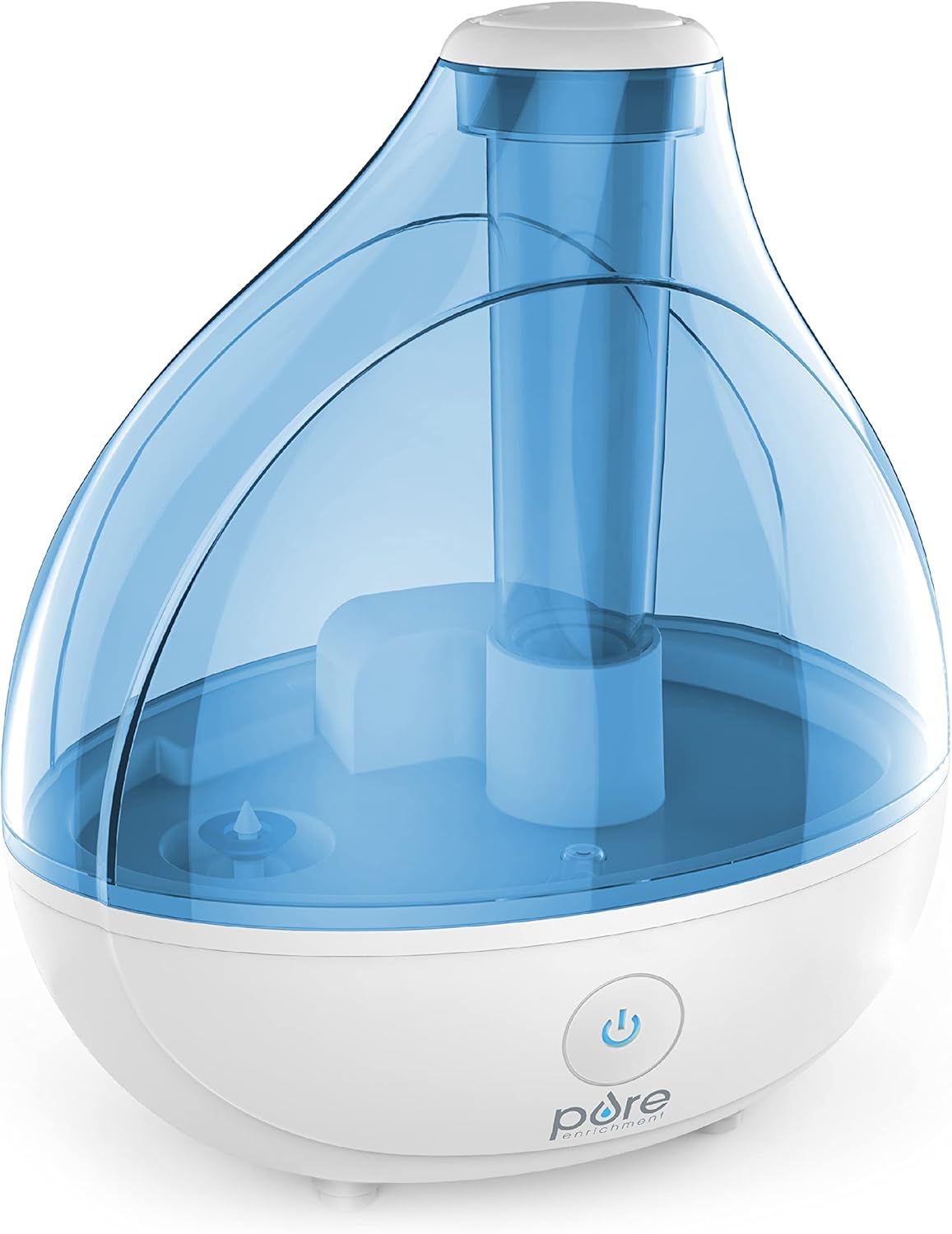
The MistAire is the most straightforward cool mist humidifier on this list: 1.5-liter tank, ultrasonic technology, 25-hour runtime on low, 360° rotating nozzle, optional night light, automatic shut-off when empty, and a five-year warranty. No app, no smart features, no filter to replace. BPA-free construction. It covers up to 250 square feet — a medium-sized bedroom or nursery — and runs whisper-quietly at levels that won’t interfere with sleep. Setup takes three minutes.
The 1.5-liter tank is small by the standards of larger room units, which means daily refills on high or every-other-day refills on low. For a bedroom where the humidifier runs only at night, that frequency is manageable. For an office running all day as well, a larger tank would be more practical. The ultrasonic design means white mineral dust is possible with hard tap water — using filtered or distilled water solves this completely. The MistAire’s simplicity is part of its value: there’s nothing complex to troubleshoot, and weekly cleaning of the tank and ultrasonic disk takes under five minutes.
Pure Enrichment’s five-year warranty is among the best in the category for a product at this price point. Most ultrasonic humidifiers in this range carry one-year coverage; five years suggests genuine confidence in build quality, and it matters for a device running every night through multiple seasons. The MistAire has accumulated tens of thousands of verified Amazon reviews with a consistently strong rating — the kind of track record that reflects real-world performance rather than launch-period hype.
Best for: bedrooms and nurseries where child safety is a priority, first-time humidifier buyers who want a reliable product without complexity, anyone who finds smart-home app management unnecessary for a single room, and households with moderate water hardness where the white dust issue is manageable with filtered water.
Vicks V745A Warm Mist Humidifier — The Illness-Season Workhorse

The Vicks V745A is what I reach for specifically during cold and flu season — not because it’s the most sophisticated unit in the category, but because it does exactly what a warm mist vaporizer should do and has been doing it reliably for years. One gallon tank, filter-free, auto shut-off when empty, a soft nightlight, and compatibility with both Vicks VapoPads (scented pads placed in a separate tray, not the water) and VapoSteam liquid for medicated vapor. The boiling process produces a genuinely hot, visible steam that fills a small to medium room quickly.
The VapoPad compatibility is the specific feature that separates Vicks from generic warm mist units in this price range. The menthol-infused pads produce a vapor that feels immediately soothing during congestion — the sensation is similar to a steam room with a mentholated towel. The medicine cup allows VapoSteam liquid to be added for a medicated camphor vapor that functions as a topical cough suppressant when inhaled. These are the use cases where warm mist genuinely outperforms cool: not year-round humidity management, but targeted symptom relief during illness.
The limitations here are the same ones that apply to all traditional steam vaporizers: it should not be used in a room with young children, it uses significantly more electricity than a cool mist unit, the heating element requires descaling in hard water areas, and the 1-gallon tank produces about 12–24 hours of output at a single fill. For anyone buying this as a dedicated illness-season device rather than an everyday humidity solution, those are acceptable trade-offs. Keep it on a high shelf well out of reach and reserve it for adult bedrooms during cold season specifically.
Best for: adults managing cold, flu, and congestion symptoms; households looking for a low-cost warm mist unit to complement a cool mist primary humidifier; anyone who already uses Vicks VapoPads or VapoSteam and wants a compatible unit; and situations where immediate, visible steam output is the priority over energy efficiency or smart features.
Vicks V750 Warm Mist Humidifier — The Wide-Tank Upgrade for Easier Cleaning

The V750 is the step-up version from the V745A — same warm mist technology, same VapoPad and VapoSteam compatibility, but with a wider tank opening that genuinely changes the cleaning experience. Warm mist vaporizers accumulate mineral scale on the heating element regularly in hard water areas, and getting a cleaning brush or cloth into a narrow tank opening is exactly the kind of annoyance that causes people to skip maintenance and end up with degraded output or bacterial buildup. The V750’s wider opening addresses that friction point directly.
It’s rated for medium to large rooms, runs quietly, and carries the same Vicks brand reliability that has made the V745A a perennial bestseller. Auto shut-off when empty is standard. The 1-gallon tank covers a full 24 hours on the lower setting, which typically covers one overnight plus a portion of the following day. Both the tank and the base require weekly cleaning in line with EPA guidance — white vinegar soak on the heating element every one to two weeks in hard water regions, thorough rinse and dry before refilling.
If the V745A is your entry point into warm mist humidification and you find cleaning it occasionally annoying, the V750’s wider tank opening is worth the modest additional cost. If you’re setting up a warm mist humidifier as a permanent fixture in a bedroom rather than pulling it out seasonally, easier maintenance translates directly to more consistent upkeep — which is the variable that matters most for indoor air quality over time.
Best for: adults who found the V745A useful but want easier cleaning access, medium to large bedrooms used exclusively by adults, anyone managing chronic respiratory conditions in winter who benefits from warm steam consistently, and households where a permanent warm-season unit justifies slightly better ergonomics than the entry-level model.
Our Verdict
The decision most buyers agonize over — cool mist or warm mist — resolves quickly once you apply two filters: who’s in the room, and are you buying for ongoing humidity management or for illness symptom relief? Children or pets in the room means cool mist. Ongoing all-winter use with electricity cost in mind means cool mist. Short-term illness relief in an adult space, or a desire to use VapoPads and VapoSteam? Warm mist earns its place. Most households, if they’re honest about their usage pattern, actually need both — a cool mist unit running every night in a bedroom and a warm mist vaporizer stored in a cabinet for cold season. The combined cost of both is still under $100.
The counter-intuitive thing about this category that most comparison guides miss: the quality of your maintenance matters more than the type you choose. A clean cool mist humidifier improves air quality. A dirty one — tank standing for three days, pink slime forming in the base — actively degrades it. The FDA’s guidance on humidifier use is explicit on this point, and it’s the variable that makes the most difference between a humidifier that helps and one that makes things worse. Clean the tank. Use distilled water in ultrasonic units. Replace wicks on schedule. The unit you’ll actually clean consistently is worth more than the unit with the best spec sheet.
On the broader question of home air quality: a humidifier addresses one variable — moisture level. If allergens, particles, or pollutants are the primary concern, an air purifier addresses a different set of problems that humidity alone doesn’t touch. The two categories are complementary, not substitutes. Similarly, if respiratory comfort during sleep is what’s driving this purchase, the best weighted blankets for sleep comfort covers another dimension of the sleep environment that pairs well with properly humidified bedroom air. And if any of this is being done in the context of managing chronic pain or physical discomfort at rest, our guide to the best lower back braces touches on structural support as another piece of the physical comfort puzzle.
For anyone buying a humidifier for a room where ultrasonic technology is already in use — whether a pest repeller, a baby monitor, or any other ultrasonic household device — it’s worth knowing that ultrasonic humidifiers and ultrasonic pest repellers operate on entirely different frequency ranges and don’t interfere with each other. Our breakdown of how ultrasonic pest repellers actually work covers that technology in detail for anyone managing both simultaneously.
Humidifier Decision Guide: Which Type Fits Your Situation
| Your Situation | Best Type | Recommended Model | Key Reason | Watch Out For |
|---|---|---|---|---|
| Baby or toddler in the room | Cool mist ultrasonic | Pure Enrichment MistAire | No heating element; no burn risk; near-silent | Use distilled water to avoid white dust |
| Adult bedroom, all-winter use | Dual mist or cool mist ultrasonic | Levoit LV600S | Energy efficient; covers large rooms; smart scheduling | Weekly cleaning required; descale warm mode plate |
| Cold/flu symptom relief, adult room | Warm mist vaporizer | Vicks V745A or V750 | VapoPad / VapoSteam compatible; immediate steam output | High energy use; keep away from children |
| Hard tap water, no white dust wanted | Evaporative cool mist or warm mist | Evaporative model or Vicks V750 | Minerals stay on wick or heating element, not in air | Wick replacement cost; fan noise (evaporative) |
| Large open-plan living space | Dual mist, large tank | Levoit LV600S | 753 sq ft coverage; 6L tank; warm mist boosts circulation | Coverage claims optimistic; pair with hygrometer |
| Budget-conscious, simple solution | Cool mist ultrasonic | Pure Enrichment MistAire | Low purchase price; 5-year warranty; no filter cost | Small tank requires daily refills on high setting |
Frequently Asked Questions
What is the main difference between a cool mist and warm mist humidifier?
A cool mist humidifier disperses water vapor at room temperature using either ultrasonic vibration or an evaporative wick. A warm mist humidifier boils water and releases the resulting steam. Both types raise indoor relative humidity effectively. The key differences are safety (cool mist has no hot water, no burn risk), energy consumption (warm mist uses roughly 4–8x more electricity), white dust production (ultrasonic cool mist can release tap water minerals; warm mist and evaporative models do not), and the sensory experience (warm mist feels more immediately soothing for congestion). Neither type is inherently superior — the right choice depends on your specific situation.
Is a cool mist or warm mist humidifier better for a baby or child’s room?
Cool mist, without exception. The American Academy of Pediatrics recommends cool mist models specifically because warm mist vaporizers contain near-boiling water and present a burn risk if tipped, touched, or reached by a child. Cool mist ultrasonic models have no heating element and pose no burn hazard. For a nursery or toddler room, this is the definitive guidance and overrides other considerations like perceived congestion relief from warm steam.
Does a warm mist humidifier use more electricity than a cool mist humidifier?
Yes — significantly. A warm mist unit typically draws 200–400 watts to maintain a rolling boil, while a cool mist ultrasonic runs at 25–50 watts. For overnight bedroom use across a full heating season, a warm mist model can cost $40–$60 more per unit in electricity annually compared to a cool mist unit at U.S. average rates. For short-term illness use, the cost difference is minimal. For continuous all-winter operation, cool mist is substantially cheaper to run.
What causes white dust from a humidifier and how do I stop it?
White dust is mineral particles — primarily calcium and magnesium — from tap water being atomized directly into the air by an ultrasonic humidifier. It settles on furniture, electronics, and surfaces near the unit. The fix is straightforward: use distilled or demineralized water, or install a demineralization cartridge in the tank. Evaporative cool mist models and warm mist vaporizers do not produce white dust because minerals are captured by the wick or deposited on the heating element rather than dispersed. The EPA’s indoor air quality guidance notes this issue specifically for ultrasonic units used with tap water.
How often should I clean my humidifier?
Rinse and dry the tank daily; perform a thorough clean with diluted white vinegar or 3% hydrogen peroxide weekly. Warm mist models need their heating element descaled every one to two weeks in hard water areas. Pink slime or black spots inside the tank mean bacterial or mold growth — stop using the unit immediately, clean thoroughly, and consider whether to replace the unit if contamination is extensive. A dirty humidifier actively worsens indoor air quality. The frequency of cleaning is the single most important maintenance variable in this category, regardless of humidifier type.
Can I use essential oils in my humidifier?
Only in a humidifier with a dedicated aroma tray or diffuser compartment, such as the Levoit LV600S. Never add essential oils directly to the water tank. Oils degrade most plastic tank materials, can cause leaks and voiding of warranties, and may introduce degraded plastic particles into the mist stream. If aromatherapy is a priority, verify aroma box compatibility before purchasing rather than discovering post-purchase that your unit doesn’t support it. The Vicks V745A and V750 use VapoPads — solid scented pads placed in a separate medicine cup tray — which is a different and purpose-built delivery system that does not involve oil contact with the water or tank.
What humidity level should I maintain in my home?
The EPA recommends keeping indoor relative humidity between 30% and 50%. Below 30%, dry air causes respiratory irritation, skin dryness, and increased susceptibility to airborne viruses. Above 60%, conditions favor mold growth, dust mite proliferation, and structural moisture damage. The 40–50% range is broadly considered optimal for both human comfort and minimizing pathogen viability. A hygrometer — available for under $15 — lets you monitor your home’s humidity level precisely. Most humidifiers with a built-in humidistat, like the Levoit LV600S in auto mode, will target a specific setpoint; without one, guessing your humidity level means either under- or over-humidifying the space.