Mosquito Trap vs Bug Zapper — The Honest Comparison for Your Yard
Last summer I finally admitted my patio was losing. Three citronella candles flickering on the table, a fan pushing air at my ankles, and still — the mosquitoes were winning. I’d held off on buying a dedicated device because I couldn’t figure out if I should get a trap or a zapper. They both promised the same thing: fewer mosquitoes, more time outside. They looked completely different and worked in completely opposite ways. So I bought one of each, ran them through a full season, and here’s what I found out.
The short version: they are not the same product. They don’t compete for the same job. And for most backyards, the “which one is better?” question has a specific, defensible answer — but you need to understand what each device actually does before that answer makes sense. If you’ve already been researching the best mosquito killer devices across different categories, this comparison will help you zero in on the right tool for your specific situation.
How Each Device Works — The Actual Mechanism
A bug zapper runs on a straightforward principle: ultraviolet light attracts flying insects, and when they contact the electrified metal grid surrounding the bulb, they’re killed on impact. The grid carries anywhere from 2,000 to 5,600 volts depending on the unit. You hear the zap. The bug is dead. It’s satisfying in a primal way, but the effectiveness depends entirely on what insects are attracted to UV light.
A mosquito trap works differently. The best ones — CO2 traps specifically — mimic the signals that make a human being appealing to a mosquito: carbon dioxide, warmth, and sometimes chemical compounds like octenol that replicate animal breath. Mosquitoes fly toward these signals expecting a meal, get sucked in by a fan, and dehydrate inside a collection basket. There’s no electric grid, no spark, no noise.
That fundamental difference in mechanism explains almost everything else about how these two devices perform in the real world.
At-a-Glance Comparison Table
| Feature | Mosquito Trap (CO2) | Bug Zapper (UV Grid) | Spatial Repeller (Thermacell) |
|---|---|---|---|
| Primary Lure | CO2, heat, octenol | UV light | Metofluthrin vapor |
| Mosquito Specificity | High — targets primary attractants | Low — kills mostly moths/beetles | High — repels, doesn’t kill |
| Coverage Area | Up to ½–1 acre | ½–2 acres (by light radius) | 110–320 sq ft (personal zone) |
| Kill Method | Fan + dehydration in basket | 5,600V electrocution grid | Repels without killing |
| Maintenance | Empty basket, replace bulb/lure | Brush grid, replace bulb | Replace refill cartridge |
| Noise Level | Whisper-quiet fan | Audible zap/crack on contact | Silent |
| Benefit to Beneficial Insects | Low collateral kill rate | High — kills moths, beetles, etc. | None killed |
| Power Requirement | Plug-in or battery (model-dependent) | Plug-in required | Rechargeable battery or butane |
| Best For | Reducing population over time | General flying insect control | Immediate personal protection |
The Mosquito Problem with Bug Zappers — What the Research Says
Bug zappers are deeply satisfying. There’s an emotional reward every time you hear that crack. But mosquitoes are not strongly attracted to UV light — they navigate toward CO2, heat, and skin odor. This was documented clearly in an American Entomologist study that analyzed the insect kill counts from six residential zappers over a full summer. Mosquitoes made up less than 1% of the total insects killed. The overwhelming majority of dead insects were moths, beetles, and midges — many of them beneficial predators or pollinators.
That’s a real problem, not just an academic one. If your bug zapper is disproportionately killing the insects that eat mosquito larvae or other garden pests, you may actually be making your mosquito situation worse over the long run. It’s a blunt instrument applied to a specific problem.
The counterargument, and it’s fair, is that a zapper with an added octenol or other chemical attractant changes this equation somewhat. The Flowtron BK-40D uses exactly this approach — UV plus a slow-release octenol lure — and the octenol does meaningfully improve mosquito attraction. It doesn’t flip the ratio entirely, but it brings more mosquitoes into the kill zone than UV alone.
Why Mosquito Traps Work Differently — And Why Patience Is Required
CO2 traps are designed around the actual biology of a mosquito’s host-seeking behavior. Mosquitoes find prey by tracking CO2 gradients in the air — they zigzag upwind toward the source. A device like the DynaTrap uses a titanium dioxide-coated surface that, when warmed by the UV bulb, reacts with moisture in the air to produce CO2. That, combined with warmth and optionally an octenol attractant sachet, creates a plausible fake host.
Here’s the catch: traps take weeks to show meaningful results. You’re not zapping individual mosquitoes as they arrive. You’re pulling egg-laying females out of the breeding cycle. Each female you trap represents hundreds of eggs that don’t get laid. That compounding effect is why serious trap users see dramatic results by mid-season even when early results feel underwhelming.
Placement also matters more than most people realize. The CDC recommends integrated mosquito management — placing controls between breeding areas and human activity zones. A trap sitting on your deck is in the wrong spot. It belongs 20 to 40 feet away, between the tree line or pond and where you actually sit.
Coverage Area — What Those Numbers Actually Mean
Both traps and zappers advertise coverage in acres, and both are optimistic. A device rated for one acre assumes flat, open terrain with consistent wind and no competing attractants. Your suburban backyard is none of those things.
In practice, mosquito traps work best at 1/4 to 1/2 of their rated coverage. A half-acre trap is appropriate for a 10,000 to 15,000 square foot yard with normal landscaping. Scale up from there if you have a pond, drainage ditch, or dense tree cover — these are mosquito-production zones that will tax any single device.
Bug zappers cast a wider light radius but, as discussed, that radius pulls in whatever insects happen to be attracted to UV — not necessarily mosquitoes specifically. So “coverage” for a zapper is less meaningful than it sounds when you’re specifically concerned about biting insects.
Upfront Cost vs. Ongoing Cost
Both types carry ongoing costs that the sticker price doesn’t show. A quality bug zapper runs $40 to $100 upfront; replacement UV bulbs typically cost $8 to $15 and should be replaced every season since UV output degrades even when the bulb still lights. Octenol attractant cartridges add $8 to $12 per 30 days if used.
A CO2 trap like the DynaTrap costs more upfront — $70 to $120 for a half-acre model — and the lure sachets run $8 to $12 per 60 days. The replacement UV bulb is another annual cost. Budget roughly $30 to $50 per season in consumables for either category of device.
The Thermacell spatial repeller category is different: the device itself is inexpensive, but repellent refill cartridges add up over a summer of regular use. It also covers a dramatically smaller area — 110 to 320 square feet depending on the model — making it personal protection rather than yard-wide control.
Noise, Aesthetics, and the Backyard Experience
Nobody talks about this, but it matters: if you’re trying to have a dinner party on your patio, a bug zapper is disruptive. The intermittent crack of electrocuted insects — and occasionally the smell — interrupts conversation. A CO2 trap is essentially silent; the fan whispers and you forget it’s running.
Aesthetically, modern mosquito traps are far more discreet than the classic lantern-shaped zapper. The DynaTrap’s basket design looks like outdoor décor. The Flowtron lantern is recognizable as a bug zapper immediately. Neither is an eyesore, but one blends in considerably better if you care about that.
The Recommended Products — Three That I’ve Looking Into
DynaTrap DT1050SR Mosquito & Flying Insect Trap — Best CO2 Trap for Most Yards

The DynaTrap DT1050SR is built from UV-resistant polycarbonate and weighs about 4.4 pounds — light enough to reposition easily, durable enough to leave outdoors through rain. The three-way lure system is the real value here: UV light, the TiO2 CO2-producing coating, and an optional octenol attractant sachet that drops into a slot on the base. The whisper-quiet fan is legitimately quiet; you can run this within 20 feet of a conversation and not notice it.
In real use, this trap excels at population reduction over a full season. By week four of continuous operation, most users report a noticeable drop in mosquito pressure. It catches a broad range of flying insects — including no-see-ums, gnats, and biting midges — not just mosquitoes. The collection basket empties by twisting off the lower cage, which takes about 30 seconds.
The honest limitation: the UV bulb needs replacement every season. This isn’t disclosed prominently at purchase. Budget for a replacement bulb. Also, it requires a power outlet, so placement is constrained by cord length (6 feet). Run it continuously — not just on evenings you plan to be outside — for the population-reduction effect to compound over time.
Best for: yards up to a quarter acre with standing water or tree cover nearby; anyone willing to run a device consistently for weeks rather than looking for instant results; households with children or pets where a chemical-free solution is preferred.
Flowtron BK-40D Electronic Insect Killer — Best Bug Zapper for a Large Yard

Flowtron makes this in the United States, which is increasingly rare in this category, and it shows in the build quality. The BK-40D uses a weatherproof polycarbonate lantern housing that won’t rust, crack, or fade. The 40-watt UV bulb pairs with a 5,600-volt non-clogging electrified grid — “non-clogging” here means the vertical grid design allows insect remains to fall through rather than accumulating and potentially causing shorts or flare-ups. The unit is UL certified, which matters for anything running outdoors on line voltage.
The octenol attractant slot is where this device separates from cheaper zappers. Insert a 30-day octenol cartridge (sold separately) and the combination of UV plus chemical lure pulls in considerably more mosquitoes than UV alone. It’s still not a CO2 trap, so the specificity for mosquitoes remains lower than dedicated traps — but for mixed flying insect problems (moths around the garden, gnats near the pond, June beetles dive-bombing your porch light), the Flowtron is genuinely effective across the board.
Where it falls short: the zap noise is real and constant in active season. Fine for a barn or edge of property; less ideal right next to a patio dining set. The UV bulb should be replaced annually. The insect remains fall to the ground, which some find cleaner than a collection tray; others find it unsatisfying not to see the count.
Best for: large properties with diverse flying insect problems; anyone who wants reliable, low-maintenance control for general pest populations; rural or semi-rural settings where noise is less of a concern.
Thermacell Radius Zone Mosquito Repeller Gen 2.0 — Best Immediate Personal Protection
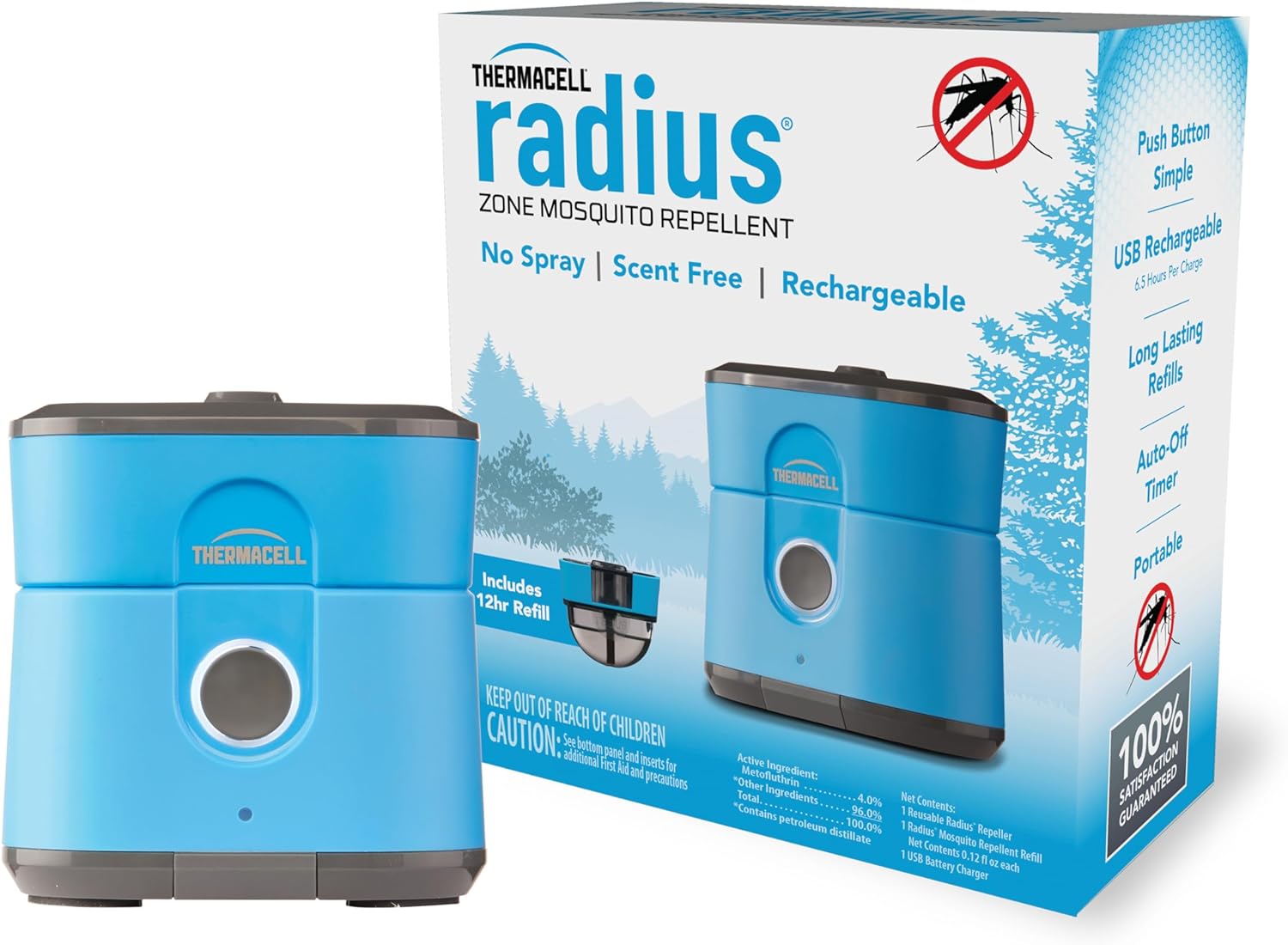
This isn’t a trap or a zapper — it’s a heat-activated spatial repeller, and it operates on a completely different logic. The rechargeable lithium-ion battery heats a liquid metofluthrin cartridge, which evaporates into a 110-square-foot mosquito-free zone around the unit. No spray, no DEET on your skin, no smoke or citronella smell. The EPA has reviewed metofluthrin at these concentrations for outdoor use safety. It repels mosquitoes including those associated with West Nile Virus and Zika. Thermacell’s claims here are substantiated — this device has a body of independent testing behind it that most bug products do not.
The tradeoff is simple: it doesn’t scale. Place this on a table at a dinner for four, and everyone within about 10 feet gets real protection. Step 15 feet away and you’re on your own. It will not protect your garden, your perimeter, or anything beyond immediate personal use. The refill cartridges are an ongoing cost that adds up over a full season of regular use.
Best for: deck dining, camping, evening gatherings in a fixed spot; anyone who wants immediate protection rather than long-term population management; households where sprays or topical repellents are not preferred for family or medical reasons.
Factors That Actually Determine Which Type You Need
Yard size and terrain matter more than most buyers consider. A flat, open 5,000-square-foot yard with no standing water and minimal tree cover is a very different problem than a 3,000-square-foot lot backing up to a wooded area with a drainage ditch. The second scenario produces so many mosquitoes that any single device will be overwhelmed — you need layered defense.
How you use your outdoor space shapes the answer too. If you’re sitting in one spot for two to three hours at a time — a patio table, a fire pit — the Thermacell Radius is the most immediate solution for that zone. If you want to reclaim the whole yard for kids playing in the afternoon, you need the broader population-reduction approach of a trap or layered system. For pool areas, where chemical residues near water are a concern, CO2 traps and spatial repellers are preferable to chemical foggers. Our coverage of the best pump sprayers covers chemical broadcast options if you’re weighing that approach separately.
Proximity to water is possibly the single biggest variable. Standing water within 100 feet of your yard — a pond, a low spot in the lawn, a neighbor’s birdbath — means you’re importing mosquitoes from a breeding factory. A trap helps reduce what comes in; eliminating or treating the water source with Bti dunks does more. Both together works best.
What Certifications and Standards Actually Mean Here
UL certification (from UL, formerly Underwriters Laboratories) on a bug zapper means the electrical design has been independently tested for shock and fire risk. For a device running line voltage outdoors in wet conditions, this is not a minor detail. The Flowtron BK-40D carries UL certification. Many cheap zappers on the market do not. When comparing products, look for UL Listed or ETL Listed on outdoor electrical devices.
The EPA reviews metofluthrin (the active ingredient in Thermacell repellers) under the Federal Insecticide, Fungicide, and Rodenticide Act. An EPA registration number on a repellent device means the efficacy and safety data have been reviewed. Products without registration numbers are making unverified claims. Check the label or product listing for the registration number before buying.
CO2 traps don’t fall under pesticide registration since they use no chemical kill agent. However, the attractant sachets (octenol, Lurex, etc.) are EPA-registered pesticide attractants. You’ll see the registration number on the cartridge packaging.
Common Mistakes People Make With Both Devices
Running a mosquito trap only when you plan to use the yard defeats the purpose. These devices work by intercepting breeding females continuously — run them 24 hours a day during mosquito season, and the population drops progressively. Running a trap three evenings a week produces marginal results.
Placing a bug zapper right over the dining table is not just ineffective, it’s a food safety concern. When insects are electrocuted, micro-particles are released into the surrounding air. The EPA has noted that placing electrocuting bug traps near food areas is not recommended. At the perimeter, 20 or more feet away, this is not a meaningful issue.
Buying undersized coverage is the most common purchasing mistake. People buy a quarter-acre trap for a half-acre yard, it performs below expectations, and they conclude that “mosquito traps don’t work.” Coverage ratings assume optimal conditions; budget for one size up from what you calculate you need.
Forgetting to replace the UV bulb annually is nearly universal. UV output degrades significantly after one season even when the bulb still illuminates. Both traps and zappers depend on that UV output for their attractant effect; a dim year-old bulb is meaningfully less effective than a fresh one. If you maintained your outdoor gear the way you maintain your lawn mower, you’d swap the bulb every spring. If you also tend to a garden, our review of heated bird baths covers how to keep your yard ecosystem balanced through other seasons as well.
Our Verdict: Mosquito Trap vs. Zapper — Which Is Better?
Here’s the thing most “best mosquito trap” roundups avoid saying: the device category matters less than whether you run whatever you buy continuously, position it correctly, and pair it with source reduction (eliminating or treating standing water). A well-placed, consistently-run trap beats an incorrectly-placed zapper. And a correctly-placed zapper with an octenol lure will outperform a trap that you only run on weekend evenings.
That said, if forced to choose one, a CO2 mosquito trap is the better investment for most suburban backyards specifically targeting mosquitoes. Bug zappers are general-purpose flying insect killers — genuinely effective for that broader category, less effective when mosquitoes are your primary problem. The research is consistent on this point: mosquitoes are poor targets for UV-only attraction. A zapper with octenol narrows this gap but doesn’t close it.
The practical recommendation from the EPA’s guidance on insect repellents and pest control options is to use an integrated approach rather than relying on any single device. A mosquito trap running continuously at the yard perimeter, a spatial repeller like the Thermacell for immediate protection during gatherings, and source reduction where possible (draining standing water, using Bti dunks in water features) is the combination that outperforms any single product. Beekeeping enthusiasts who maintain hives might also consider how their nearby pollinator population interacts with these control methods — our coverage of beekeeping equipment addresses protective gear for working around managed pollinators.
If your budget allows only one purchase, buy the DynaTrap DT1050SR, add the octenol lure sachet, position it correctly, run it continuously, and give it a full month before judging the results. That combination — right device, right placement, adequate time — is what closes the gap between “this thing doesn’t work” and “I actually enjoy my patio again.” For a comprehensive look at everything in this category, our guide to all mosquito killer devices covers the full range from yard foggers to repellent bracelets.
Frequently Asked Questions – Mosquito Trap vs Bug Zapper
Do mosquito traps actually reduce mosquito populations?
Yes, mosquito traps can reduce local populations over time when used consistently. CO2-based traps like the DynaTrap intercept mosquitoes before they bite and breed, which breaks the reproductive cycle. The CDC notes that integrated pest management — combining multiple control methods — yields the best results. A single trap alone is unlikely to eliminate all mosquitoes in a given area, especially near water sources.
Can a bug zapper kill mosquitoes effectively?
Bug zappers kill mosquitoes, but research suggests they are not highly effective as a primary mosquito control method. A landmark study published by the American Entomologist found that less than 1% of insects killed by UV zappers were mosquitoes; the majority were moths and beetles. Zappers with added octenol attractant (like the Flowtron BK-40D) perform better, but still work best as part of a broader pest control strategy.
Where should I place a mosquito trap in my yard?
Place a mosquito trap between insect breeding areas (standing water, dense vegetation) and the areas where people gather. DynaTrap recommends positioning the unit 20 to 40 feet away from seating areas. Height also matters — approximately 3 to 6 feet off the ground puts the trap in the flight path of most mosquito species. Run it continuously rather than only when you plan to use the yard.
How far away from people should a bug zapper be placed?
Bug zappers should be placed at least 15 to 25 feet away from people and food areas. The reason is that zapping insects can aerosolize bacteria and viruses present on the bugs, which can land on nearby surfaces. The EPA recommends against placing any electric insect killer near food preparation or consumption areas. Place zappers at the perimeter of the space you want to protect, not directly above it.
Are mosquito traps safe for pets and children?
Mosquito traps like the DynaTrap are generally safe around pets and children because they use no chemical sprays or high-voltage grids in direct contact. Bug zappers carry a higher risk — the electrified grid can injure a curious pet or child who touches it. Thermacell-type repellers use metofluthrin, an EPA-evaluated active ingredient, at concentrations considered safe for outdoor use. Always position any device out of reach and follow manufacturer placement instructions.
What attracts mosquitoes to traps — CO2 or UV light?
Mosquitoes are primarily attracted to CO2 (carbon dioxide), body heat, and certain chemical compounds like lactic acid — not UV light. UV light attracts many other flying insects but is a weak lure for mosquitoes specifically. This is a key distinction: CO2-emitting traps like the DynaTrap are more effective at targeting mosquitoes, while standard UV bug zappers tend to kill more beneficial insects such as moths and beetles.
Can I use a mosquito trap and bug zapper at the same time?
Yes, and it can be an effective layered approach. Place the mosquito trap between your breeding area and your seating zone to intercept mosquitoes in transit. Position the bug zapper at the edge of your property to knock down general flying insect populations. Combined with a spatial repeller like a Thermacell for immediate personal protection, this three-layer strategy covers what no single device can do alone.