Best Electric Toothbrush Under $50: What Actually Cleans Better — and What’s Just Marketing
My dentist said something at my last cleaning that stuck with me. She said she could always tell which of her patients used electric toothbrushes, not because of any dramatic difference in tooth whiteness, but because of gum health. The patients who brushed manually — even the conscientious ones who brushed twice a day for two full minutes — tended to have more localized inflammation along the gumline. The electric toothbrush users had more consistent contact along the gumline because the motor was doing the work, not their wrist. She used one herself. A Philips Sonicare. Not the $300 version — the $45 one.
That conversation is why I resist the framing that electric toothbrushes are a luxury upgrade. The clinical case for powered brushing is solid and well-documented. What is a luxury upgrade — or at least an optional one — is spending more than $50 on an electric toothbrush. The features that push a brush into the $150–$350 range are Bluetooth connectivity, app integration, multiple pressure sensor modes, and premium handle finishes. None of those features clean your teeth better than what’s available at the under-$50 price point. The motor, the timer, and the pressure sensor — the features that actually improve brushing outcomes — are all available here.
This guide covers what separates an oscillating brush from a sonic one, why the ADA Seal matters and what it actually verifies, which specifications are real differentiators versus marketing noise, and the three specific brushes that earn their place in the under-$50 bracket for different reasons.
Quick Comparison: Best Electric Toothbrushes Under $50
| Model | Type | Brush Motions | Pressure Sensor | Modes | Battery Life | Best For |
|---|---|---|---|---|---|---|
| Oral-B Pro 1000 | Oscillating-rotating | 8,800 oscillations/min | Yes — stops pulsations | 3 (Daily Clean, Gum Care, Sensitive) | ~2 weeks per charge | Plaque fighters, heavy brushers |
| Philips Sonicare 4100 | Sonic vibration | 31,000 strokes/min | Yes — reduces vibrations | 1 (+ 2 intensity settings) | ~14 days per charge | Sensitive gums, first-time users |
| Aquasonic Black Series | Sonic vibration | 40,000 VPM | No | 4 (Clean, Soft, Whiten, Massage) | ~30 days per charge | Whitening focus, travelers |
| Manual toothbrush | Manual | Human-powered | No | N/A | N/A | Technique-perfect users only |
| Premium electric ($150+) | Oscillating or sonic | Similar to budget models | Yes — multi-sensor | 5–12 + Bluetooth app | 3–4 weeks | Tech enthusiasts, Bluetooth users |
The Clinical Case: What Research Says About Electric vs Manual
The evidence base for powered toothbrushes is substantial. A landmark systematic review published in the Cochrane Database of Systematic Reviews — the gold standard for clinical evidence evaluation — analyzed studies comparing powered and manual toothbrushes and found that powered brushes reduced plaque by 21% and gingivitis by 11% more than manual brushing after three months of use, with benefits continuing at longer follow-up intervals. These are not trivial differences. Gingivitis — gum inflammation from plaque buildup — is the precursor to periodontitis, the leading cause of tooth loss in adults.
The American Dental Association’s position is clear and worth quoting directly. The ADA recommends brushing teeth twice a day with a soft-bristled brush and notes that powered toothbrushes can be helpful for people with limited manual dexterity, those who tend to brush too hard, and anyone who finds the experience of powered brushing more motivating to maintain consistent habits. That last point is underrated: the research consistently shows that the people who brush twice a day for two minutes get the benefit, and anything that makes that habit easier to maintain has downstream clinical value.
What the research also shows — and what most buyers guide coverage doesn’t emphasize enough — is that the additional features of premium electric toothbrushes don’t produce better cleaning outcomes than their budget counterparts. The Bluetooth coaching system in a $300 Oral-B iO doesn’t clean better than the timer in a $40 Pro 1000. It might, for some users, improve brushing technique through real-time feedback. For most users, the 2-minute timer and the 30-second quadrant pacer achieve essentially the same result.
Oscillating vs Sonic: The Technology Difference That Actually Matters
Two fundamentally different cleaning mechanisms dominate the electric toothbrush market, and the distinction is worth understanding before choosing between them.
Oscillating-Rotating Technology (Oral-B)
Oral-B’s approach uses a small, round brush head that rotates alternately clockwise and counterclockwise while simultaneously pulsating in and out. The rotating action is designed to surround individual teeth — the circular head contours around each tooth surface to break up plaque through mechanical scrubbing. At 8,800 oscillations and 40,000 pulsations per minute, the motor is doing significantly more scrubbing work per second than a manual brush. The key advantage: direct, mechanical contact with the tooth surface, which is particularly effective for heavy plaque in patients who have let their dental hygiene slip.
Sonic Technology (Philips Sonicare, Aquasonic)
Sonic toothbrushes use a conventional-shaped brush head (similar to a manual toothbrush) that vibrates at extremely high frequency — 31,000 strokes per minute for the Sonicare, 40,000 vibrations per minute for the Aquasonic. At these frequencies, the brush doesn’t just scrub where the bristles touch; the rapid movement creates fluid dynamics in the saliva and toothpaste in the mouth, generating cleaning action slightly beyond the bristle contact zone. This is why sonic brushes are often described as gentler despite their high speed — the cleaning happens partly through fluid motion rather than entirely through direct abrasion. For people with sensitive gums or receding gum tissue, this mechanical difference is meaningful.
In independent clinical comparisons, both technologies outperform manual brushing, and neither consistently outperforms the other across all metrics. Oscillating-rotating tends to perform slightly better in short-term plaque removal in heavily plaque-laden mouths. Sonic tends to produce slightly better gum health outcomes in long-term studies, possibly because the gentler feel encourages users to brush more thoroughly without avoiding sensitive areas. The choice between them, at the under-$50 price point, is primarily a preference question.
Recommended Electric Toothbrushes Under $50
Oral-B Pro 1000 — The Dentist-Backed Standard at Its Best Price

The Oral-B Pro 1000 is the entry point to Oral-B’s oscillating-rotating platform, and it includes the features that matter without the ones that don’t. The CrossAction brush head — bristles angled at 16 degrees to surround each tooth — oscillates, rotates, and pulsates to break up and remove plaque along the gumline in a way that flat-headed brushes, manual or sonic, can’t replicate through geometry alone. Three cleaning modes cover the core use cases: Daily Clean for standard brushing, Gum Care for a gentler pulsating massage along the gumline, and Sensitive for users with sensitivity or recent dental work. The in-handle timer pulses every 30 seconds to signal a quadrant change and shuts off at two minutes — the dentist-recommended brushing duration that most manual brushers don’t consistently hit.
The pressure sensor is the feature that earns the most consistent praise in real-world use. When you brush too hard — and most people do, particularly when switching from manual brushing — the sensor stops the pulsating motion immediately. Not a gentle warning light you might miss: the brush physically stops doing what makes it effective. That immediate feedback trains better brushing technique faster than any app-based coaching system in more expensive brushes, precisely because the consequence of over-brushing is instant and unmistakable. The rechargeable battery charges on the included inductive charging base and lasts approximately two weeks of twice-daily use.
The honest limitation: the round brush head is bulkier than a flat sonic head and can be difficult to maneuver to the back molars in users with smaller mouths or a strong gag reflex. The charging base requires a dedicated bathroom outlet spot — it’s not a USB charger, which matters for travel. The handle is hard plastic with no rubberized grip zone, and wet hands do reduce grip security somewhat. And while Oral-B brush head replacements are widely available, genuine Oral-B heads cost more per head than Sonicare equivalents — though third-party compatible heads are plentiful and substantially cheaper.
Best for: Anyone who wants the most mechanically direct plaque removal at this price point, users with heavy plaque buildup who need more than gentle vibration to achieve results, and people whose dentists have specifically recommended oscillating technology. The Oral-B Pro 1000 is the brush recommended most frequently by dentists in the US, and that recommendation is backed by a clinical track record, not just brand loyalty.
Philips Sonicare 4100 — The Gentle Sonic Upgrade for Sensitive Gums and New Converts
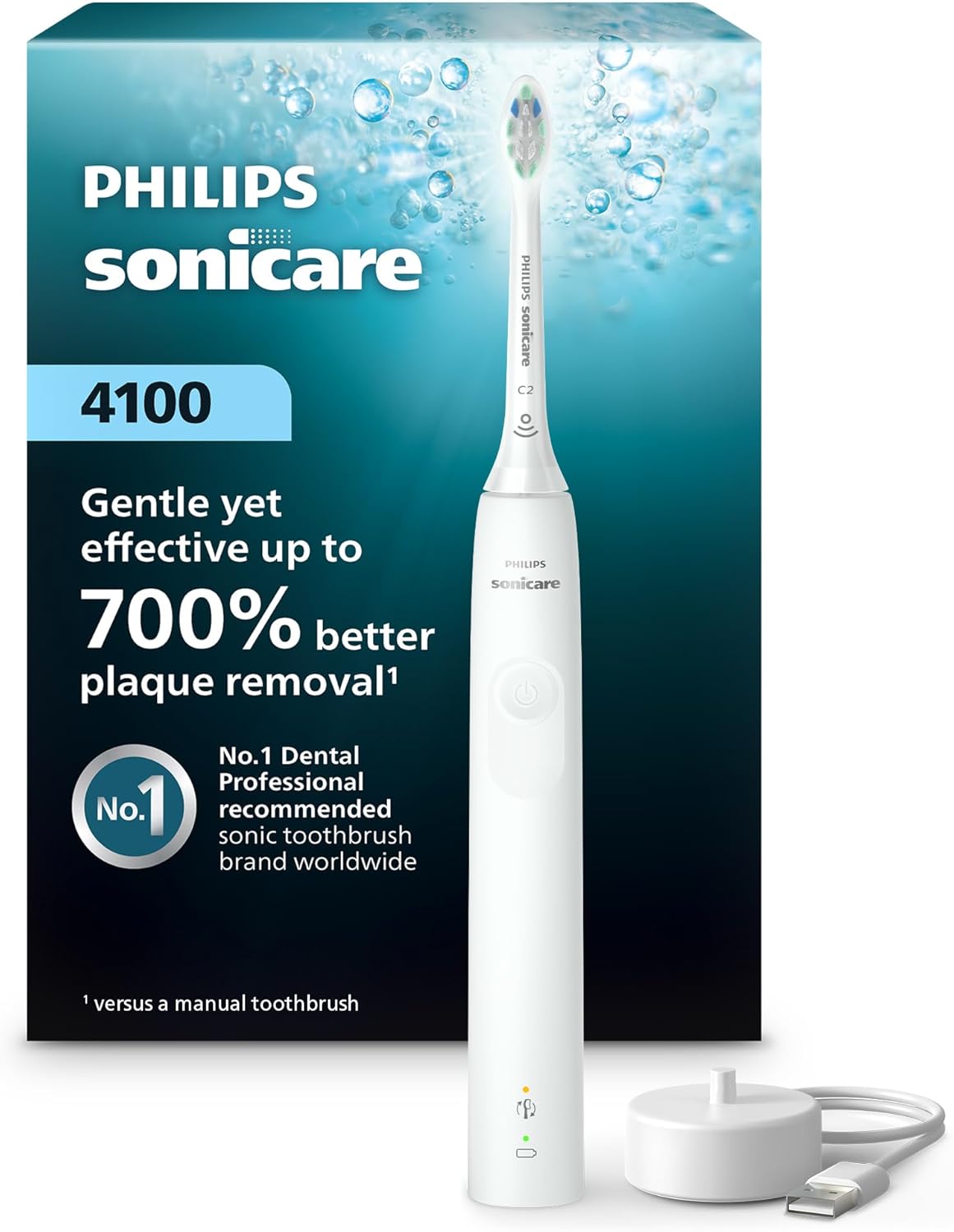
The Philips Sonicare 4100 is the most user-friendly entry point to sonic brushing, designed around the premise that the biggest obstacle to electric toothbrush adoption isn’t price — it’s the sensation. The EasyStart feature automatically runs the brush at a lower intensity for the first 14 uses, gradually increasing to full power as the user adjusts to the feeling of sonic vibration. For people who have tried and abandoned electric toothbrushes because the intensity felt overwhelming, this graduated approach is the most thoughtful design decision in the under-$50 bracket. The two intensity settings — standard and sensitive — remain available permanently, not just during the adjustment period, giving users ongoing control over the cleaning experience.
The pressure sensor works differently from the Oral-B’s mechanism: when it detects excess pressure, it automatically reduces the brush’s vibration intensity and emits a pulsing signal rather than stopping entirely. This gentler intervention suits sensitive users who might find a complete stop jarring. The SmarTimer and QuadPacer — identical in concept to the Oral-B’s timer system — ensure two full minutes of brushing with 30-second quadrant prompts. The C2 Optimal Plaque Control brush head included in the box is a quality starting point; the full Sonicare head lineup includes options for whitening, gum health, and sensitive use, all compatible with the 4100 handle. Battery life runs approximately 14 days on a full charge, with a USB charging cable included — a practical upgrade over the proprietary charging pucks on older Sonicare models.
The limitation most worth naming: one cleaning mode is limiting for users who want to customize their brushing experience. The Sonicare 5100, at a typically higher but still sub-$60 price point, adds two additional modes including Gum Care and Sensitive. For users with specific gum health concerns, stepping up is worth considering. The 4100 also uses a brush head replacement reminder — the blue indicator bristles fade to white over three months — which is useful but means the included head’s color change can be mistaken for a quality issue by first-time users who don’t know what to expect.
Best for: People switching from manual brushing for the first time, users with sensitive gums or gum recession, anyone who has found electric brushing uncomfortable in the past, and households where multiple users with different sensitivity levels share a brush handle and use their own heads. The EasyStart system alone makes this the most accommodation-friendly electric toothbrush in its price range.
Aquasonic Black Series — The Value-Packed ADA Sonic Brush with 8 Heads Included

The Aquasonic Black Series earns its place on this list through an unusually complete package and the ADA Seal of Acceptance — the gold-standard independent certification that the brush has been tested and verified effective for plaque removal and safe for enamel and gum tissue. At 40,000 vibrations per minute, it operates at the upper end of sonic toothbrush power, with four brushing modes covering Clean, Soft, Whiten, and Massage. The wireless charging base — a glass that doubles as a rinsing cup — is a design element that typically appears only on brushes at significantly higher price points. Eight DuPont-engineered brush heads are included in the box, representing more than two years of replacements at the recommended three-month interval, which substantially improves the effective price-per-use compared to brushes that ship with a single head.
The battery runs approximately 30 days per charge — the longest in this guide by a significant margin, making this the obvious choice for travelers who find carrying a charger inconvenient. The handle carries an IPX7 waterproof rating, meaning it can be submerged up to one meter of water, which matters for anyone who showers while brushing or needs to fully rinse the handle. The included hard travel case protects the brush and heads during transit without adding significant bulk to a toiletry bag.
The honest trade-off: no pressure sensor. In a sonic brush running at 40,000 VPM, over-brushing is a real risk for users who press hard against their teeth — there’s no mechanism to alert them when they’re applying damaging force. Users with existing gum sensitivity or recession who are prone to heavy-handed brushing should be aware of this limitation and consciously adopt a light-touch technique. The Soft mode helps by reducing motor intensity, but it doesn’t address technique in the way a dedicated pressure sensor does. The brush heads also use a proprietary connection that limits replacement options to Aquasonic-compatible heads, whereas Oral-B and Sonicare both have broad third-party replacement head ecosystems.
Best for: Value-focused buyers who want ADA-accepted sonic cleaning power, travelers who prioritize battery life and portability, and anyone who wants whitening modes and a premium aesthetic without premium pricing. The bundle value — brush, eight heads, wireless charging base, travel case — at this price point is genuinely unusual and worth factoring into the purchase decision alongside the performance specs.
The ADA Seal: What It Actually Verifies
The ADA Seal of Acceptance is earned through a voluntary evaluation process in which manufacturers submit evidence — published clinical studies, laboratory test data, ingredient and formulation information — demonstrating that their product is safe and effective for its intended use. For electric toothbrushes, the evaluation specifically tests plaque removal efficacy and safety for enamel and gum tissue. Products that earn the seal are subject to ongoing review and can lose it if formulations or designs change without resubmission.
The ADA Seal is not a ranking. A brush that carries the seal is verified safe and effective; a brush without the seal may also be safe and effective, but has either not applied or not met the ADA’s submission requirements. Both Oral-B Pro 1000 and Aquasonic Black Series carry ADA acceptance. Philips Sonicare products carry ADA acceptance as a brand category. When evaluating any electric toothbrush — in this price range or any other — the presence of ADA acceptance is the most reliable third-party verification available.
Electric Toothbrush Feature Comparison by Brushing Profile
| Brusher Profile | Key Need | Most Important Feature | Recommended Brush | Reason |
|---|---|---|---|---|
| First-time electric user | Comfortable adjustment | EasyStart / gentle mode | Philips Sonicare 4100 | Gradual power ramp-up over 14 uses |
| Heavy plaque / dentist feedback | Maximum plaque removal | Oscillating-rotating mechanism | Oral-B Pro 1000 | Direct mechanical scrubbing at gumline |
| Sensitive gums / recession | Pressure protection | Pressure sensor | Oral-B Pro 1000 or Sonicare 4100 | Both include active pressure limiting |
| Frequent traveler | Long battery life + portability | 30-day battery + travel case | Aquasonic Black Series | 30-day charge + hard case included |
| Value-focused buyer | Best total package per dollar | ADA acceptance + 8 heads included | Aquasonic Black Series | 2+ years of heads + wireless charging base |
Brush Heads: The Ongoing Cost Nobody Calculates First
The total cost of an electric toothbrush over two years is the purchase price plus the cost of replacement heads at three-month intervals — eight heads in two years. Genuine Oral-B CrossAction heads run approximately $7–$10 each at retail, or $4–$6 each in 6-packs. Genuine Sonicare C2 heads run similarly. At those prices, two years of replacement heads adds $32–$80 to the total cost depending on purchasing approach. The Aquasonic’s eight included heads eliminate this cost for the initial two-year period entirely.
Third-party compatible heads for Oral-B and Sonicare platforms are available at $2–$4 per head and perform adequately for most users, though bristle quality and head geometry consistency varies by manufacturer. If you plan to use third-party heads, the broader compatibility ecosystem of Oral-B and Sonicare — with hundreds of compatible options — is an advantage over the narrower Aquasonic ecosystem. For those who prefer to maintain consistent experience and always use brand-name heads, factor in that ongoing cost before choosing purely on initial purchase price.
Sensitive Teeth and Gums: Which Brush to Choose
Sensitivity in the context of electric toothbrushes usually means one of two things: tooth sensitivity from exposed dentin near the gumline, or gum sensitivity from existing recession or inflammation. The choice of brush — and brushing approach — differs slightly for each.
For tooth sensitivity, the cleaning mode matters more than the brushing technology. The Oral-B Pro 1000’s Sensitive mode reduces motor intensity; the Sonicare 4100’s EasyStart and two-intensity system accomplish similar goals. Both allow brushing with reduced power in the areas of highest sensitivity while maintaining normal cleaning elsewhere. Using a sensitivity-formulated toothpaste with either brush further reduces discomfort during the adjustment period.
For gum recession and gum sensitivity, the pressure sensor is the most important feature — over-brushing is the leading mechanical cause of gum recession, and the habit of pressing too hard at the gumline is more common than most people realize. Both the Oral-B Pro 1000 and Sonicare 4100 include pressure sensor mechanisms. The Aquasonic Black Series does not. For a user with documented gum recession or diagnosed gum sensitivity, the absence of a pressure sensor in the Aquasonic is a meaningful reason to choose one of the other two options despite the Aquasonic’s otherwise strong value proposition. Good oral health habits extend beyond brushing — the same attention to daily routine that an electric toothbrush supports applies to other areas of physical comfort and health, including topics we cover in our guide to the best heating pads for muscle and joint pain relief, which similarly separates clinical benefit from marketing noise at accessible price points.
The Two-Minute Timer: Why It Matters More Than Any Other Feature
The single feature with the most documented impact on brushing outcomes is the two-minute timer. Studies consistently show that most people brush for 45 seconds to 75 seconds when relying on their own sense of time — less than half the dentist-recommended two minutes. Electric toothbrushes with built-in timers that enforce the full two-minute duration address this gap directly and mechanically. All three brushes in this guide include a two-minute SmarTimer or equivalent, with 30-second quadrant pacer prompts to guide even coverage across all four sections of the mouth.
This is the feature that justifies the investment in an electric toothbrush even before considering the cleaning technology advantage. A manual toothbrush used for two full minutes with proper technique outperforms a poorly timed electric session. An electric toothbrush that enforces the correct duration combines the timing discipline with the cleaning technology advantage — and that combination is where the clinical benefit accumulates over years of use. For anyone building or rebuilding a daily oral health routine, the timer is the place to start evaluating any toothbrush, electric or otherwise.
Travel Considerations
All three brushes in this guide are rechargeable rather than battery-powered, which means they need a charging solution for trips. The Aquasonic’s 30-day battery life means it can often travel without the charger at all for trips under two weeks. The Oral-B Pro 1000’s inductive charging base is bulkier than a USB cable but is compatible with standard power adapters globally with a voltage adapter. The Sonicare 4100 uses USB charging — more travel-friendly than the Oral-B’s charger in terms of portability, since any USB power source works.
For frequent travelers, the Aquasonic’s included hard travel case, 30-day battery, and USB charging option make it the most capable travel companion in this group. The Oral-B Pro 1000 works well for road trips where outlet access is reliable; the Sonicare 4100 falls in between, with good battery life and convenient USB charging. For a more comprehensive approach to travel health equipment, our guide to portable storage and organization for travel covers the broader question of keeping your health and personal care kit organized on the road.
What the Under-$50 Bracket Doesn’t Get You
Being direct about the trade-offs at this price point is more useful than pretending the budget bracket is identical to the premium one. What you don’t get under $50: AI-powered brushing guidance and coverage mapping (Oral-B iO Series), pressure sensors that track zone-by-zone data over time (iO and some Sonicare 9000-series), Bluetooth app integration with brushing coaching, premium handle materials like matte aluminum or soft-grip silicone, and UV sanitizing charging bases. These are real features that some users genuinely benefit from — particularly the app-based coaching for people who want granular feedback on brushing coverage.
What you do get: the same core oscillating or sonic cleaning technology, a 2-minute timer with quadrant prompts, a pressure sensor (on Oral-B and Sonicare), rechargeable battery with 2-week runtime, and — on the Aquasonic — an ADA Seal, four brushing modes, wireless charging, and eight replacement heads. The premium features are optional additions to a foundation that’s already clinically effective. For the majority of users — including my dentist — the foundation is all that’s needed.
Our Verdict
The counter-intuitive truth about electric toothbrushes that this category’s marketing consistently obscures: your technique and your consistency matter more than which brush you choose within any given price tier. An Oral-B iO used for 60 seconds in a hurry cleans less effectively than an Oral-B Pro 1000 used properly for two full minutes twice a day. The brush is a tool; the habit is the health outcome. Buying a better brush than you’ll use isn’t an upgrade — it’s an expensive way to feel virtuous.
Within the under-$50 bracket, the Oral-B Pro 1000 is the recommendation that requires the fewest qualifications for the fewest types of users. It has the widest body of clinical research behind its oscillating technology, the most widely available replacement heads, and a pressure sensor that genuinely trains better technique. For people with sensitive gums or who are new to electric brushing, the Sonicare 4100’s EasyStart feature and gentler sonic feel make the transition more comfortable and more likely to stick. The Aquasonic Black Series is the best value-per-dollar in the bracket if you don’t need a pressure sensor — the combination of ADA acceptance, four modes, 30-day battery, and eight included heads is hard to match at its price point.
One more thing worth saying directly: the best electric toothbrush under $50 is the one you’ll actually use every day. If the Oral-B’s round head has always felt awkward to you, the Sonicare’s familiar flat head will get used more consistently, and consistent use of a slightly less aggressive brush beats occasional use of the more aggressive one every time. Choose the brush that fits your mouth, your sensitivity level, and your daily bathroom routine — and then trust the two-minute timer to do the rest. For anyone building a broader daily wellness and self-care routine alongside better brushing habits, our overview of grooming tools built for consistent daily use reflects the same principle: the best tool is the one engineered for your actual routine, not a theoretical ideal version of it.
Frequently Asked Questions about the Best Electric Toothbrush Under $50
Is an electric toothbrush under $50 actually effective?
Yes — clinical research consistently shows that powered toothbrushes reduce plaque and gingivitis more effectively than manual brushing, and this benefit applies equally to budget and premium models. A Cochrane review of powered vs manual toothbrushes found powered brushes reduced plaque by 21% and gingivitis by 11% more than manual brushing at the three-month mark. The core cleaning technology — the oscillating or sonic motor, the 2-minute timer, the pressure sensor — is all present at the under-$50 price point. The features that push brushes above $100 (Bluetooth, app coaching, premium materials) are additions to this foundation, not improvements to it.
What is the difference between oscillating and sonic electric toothbrushes?
Oscillating toothbrushes (like Oral-B) use a round head that rotates back and forth, scrubbing plaque directly off tooth surfaces. Sonic toothbrushes (like Philips Sonicare and Aquasonic) vibrate a standard-shaped head at high frequency — 31,000 to 40,000 strokes per minute — creating fluid dynamics in the mouth that help dislodge plaque slightly beyond bristle contact. Both are clinically proven to outperform manual brushing. Oscillating tends to feel more aggressive and may be better for heavy plaque buildup; sonic tends to feel gentler and suits sensitive gums or first-time electric brush users. The choice is largely personal preference at this price point.
Do I need a pressure sensor in an electric toothbrush?
A pressure sensor is one of the most practically useful features in any electric toothbrush. Brushing too hard is the leading cause of enamel erosion and gum recession — and the power of an electric motor makes it easy to apply excess force without feeling it. A sensor that stops pulsations (Oral-B) or reduces vibration intensity (Sonicare) when you press too hard trains better technique over time in a way no verbal reminder can match. Of the three brushes in this guide, the Oral-B Pro 1000 and Sonicare 4100 both include pressure sensors; the Aquasonic Black Series does not. For users with existing gum sensitivity or recession, this distinction matters.
How often should I replace electric toothbrush heads?
The American Dental Association recommends replacing toothbrush heads every three to four months, or sooner if bristles appear frayed or worn. Worn bristles lose both the stiffness and the bristle angle geometry that makes electric brushing more effective than manual — a three-month-old brush head with splayed bristles cleans no better than a soft manual brush. Most quality brush heads include a color-fade indicator on the bristles that progressively bleaches over three months as a visual replacement reminder. The Aquasonic’s eight included heads provide two-plus years of replacements without additional purchase.
What is the ADA Seal and why does it matter for electric toothbrushes?
The ADA Seal of Acceptance is issued by the American Dental Association to products that have completed an independent scientific review confirming safety and efficacy for their stated purpose. For electric toothbrushes, this means the brush has been tested for effective plaque removal and verified safe for enamel and gum tissue. The evaluation is voluntary — not every good brush applies — but ADA acceptance is the most reliable independent verification available to consumers short of reading the primary clinical literature. The Aquasonic Black Series carries ADA acceptance; Oral-B and Philips Sonicare carry it as brand-level certifications across their product lines.
Are replacement brush heads expensive for budget electric toothbrushes?
Replacement heads are the ongoing cost of electric toothbrush ownership and worth factoring into the purchase decision. Genuine Oral-B and Sonicare heads typically run $5–$10 each, or $3–$6 each in multipacks. At three-month replacement intervals, that’s roughly $12–$40 per year per user. Third-party compatible heads for both platforms are available at $2–$4 per head. The Aquasonic Black Series includes eight heads at purchase, eliminating the replacement head cost for the first two-plus years — a meaningful value differentiator when calculating total cost of ownership over that period.
Can people with sensitive teeth or gums use an electric toothbrush?
Yes — and electric toothbrushes often produce better outcomes for sensitive users than manual brushing, because the pressure sensor and consistent motor power prevent the over-brushing that causes much sensitivity in the first place. The Sonicare 4100’s EasyStart feature (gradually increasing power over 14 sessions) and two intensity settings are specifically designed for sensitive-user onboarding. Soft replacement brush heads, available for all three brushes in this guide, further reduce abrasion. For users with documented gum recession, the pressure sensor — present on the Oral-B Pro 1000 and Sonicare 4100, absent on the Aquasonic — is the key feature to prioritize.